You've got a bird in view at the edge of a marsh, and your 10x monocular just won't bring it closer. That's the moment birders start asking: When does a birding monocular become a spotting scope? The short answer is that there's no hard number, but the practical line sits around 12x to 15x magnification.
Manufacturer specs show most birding monoculars stay between 8x and 12x, while compact spotting scopes typically start at 15x or 20x. As of 2026, the real dividing line is stability. A monocular in your hands is a monocular.
Put it on a tripod and push past 12x, and you're effectively using a spotting scope.
Quick Answer: Where the Line Actually Is
A birding monocular becomes a spotting scope at about 12x magnification with a tripod mount. The optics are nearly identical in that zone. The difference is stability and size.
Need to identify a distant bird? You need a scope. Scanning on the move?
A monocular wins.
Why This Question Matters for Birders
Most birders buy a monocular because it's light, simple, and one-handed. Then they hit a forest clearing with a distant hawk. Suddenly 10x doesn't feel like enough.
That's the exact moment the monocular-versus-scope question stops being theoretical.
It's not just about magnification. A 12x monocular and a 16x spotting scope can look similar on paper. But the scope has a larger objective lens, a rigid tripod mount, and an eyepiece designed for precise focusing.
Those differences change how you actually use it.
Manufacturers define products by form factor, not just lens specs. A monocular is handheld by design. A spotting scope is tripod-mounted by design.
The crossover happens when you ignore intended uses and start adapting the gear. If you're weighing the two formats, that trade-off between portability and reach is worth reading before you buy.
For example, many birders attach a 15x zoom monocular to a lightweight tripod for shorebird watching. At that point, it behaves exactly like a compact spotting scope. So the real question isn't "what's it called?" It's "what are you asking the gear to do?"
The Case for a High-Power Monocular
What a Modern Birding Monocular Can Do
Modern monoculars have come a long way. A 10×42 model with ED glass resolves fine plumage detail at short range. With a 50mm objective lens, they gather enough light for dim forest conditions.
Some versions offer variable magnification, from 8x to 24x, which puts them right in spotting scope territory.
As of 2026, a quality zoom monocular is genuinely compact for its reach. Most weigh between 10 and 15 ounces. That's the whole appeal.
It fits in a jacket pocket and can be drawn faster than people expect.
Where It Starts to Struggle
The struggle begins when magnification climbs past 12x. Even a steady person produces micro-shake at that range. That shake turns a crisp warbler into a bouncing blur.
You end up with a 15x optic that shows you less than a steady 8x pair.
Another issue is field of view. High-power monoculars have a narrow field, often under 200 feet at 1000 yards. Finding a bird requires your naked eye to locate the target first.
Then you raise the monocular to the exact spot. For quick-moving birds like kingfishers, that process fails.
The platform matters more than the glass. Without stability, the extra magnification is wasted. That's why a tripod becomes the game-changer.
The Case for a Compact Spotting Scope
What a Small Scope Offers
A compact spotting scope, typically a 50mm to 60mm objective with a zoom eyepiece, is built for sturdy viewing. It's heavier than a monocular, but far lighter than a full-size 80mm scope. The key difference is the tripod collar and the rigid mounting point.
That collar locks the optic onto a head and keeps it perfectly still.
Once stable, magnification becomes useful. At 30x or 40x, you can read the color of a bird's legs, the shape of its bill, or the fine scalloping on feathers. These are identification features you simply cannot see at 10x in a handheld optic.
The eyepiece also tends to have better eye relief for eyeglass wearers.
The Tradeoffs You Inherit
Compact scopes aren't perfect. They add weight and bulk, and they need a tripod. That means setup time, more gear, and a harder time tracking birds on the move.
You also lose the ease of one-handed operation. A scope can't be lifted like a monocular when a bird flashes past.
There's also a cost factor. A good compact spotting scope costs more than a high-power monocular of similar optical quality. You're paying for the mechanical precision of the eyepiece, the tripod mount, and the larger glass.
For some birders, that's worth it. For others, it's unnecessary expense.
Side-by-Side: Monocular vs. Spotting Scope at a Glance
| Factor | Birding Monocular | Compact Spotting Scope |
|---|---|---|
| Typical magnification | 8x–12x | 15x–45x |
| Field of view | Wide, easier to find birds | Narrow, requires precise aim |
| Stability | Handheld, some shake above 10x | Tripod-mounted, steady |
| Weight range | 10–15 oz | 30–55 oz plus tripod |
| Setup time | Instant | 1–3 minutes |
| Price range | $50–$600 | $300–$1,500+ |
Magnification and Stability
Monoculars usually top out around 10x or 12x unless you go specialized. Spotting scopes start around 15x and zoom to 40x or more. The bigger jump in magnification demands a stable platform.
Without one, the extra power works against you. If you've ever tried holding a 10x monocular steady, you know this instantly.
Field of View and Finding Birds
A monocular's wide field makes spotting birds fast. A scope's narrow field means you need to locate the bird first with your eye, then align the scope. That's why birders often use both.
The monocular finds, the scope confirms.
Glass Quality and Brightness
In both designs, the objective lens diameter sets the light-gathering ceiling. A 42mm monocular and a 50mm scope both gather plenty of light during the day. But an 80mm scope only finds its advantage at dawn and dusk.
For daytime birding, good glass matters more than huge lens.
If you're choosing between common sizes, our breakdown of 8×32 and 8×42 monoculars shows how objective size affects the view. And per guidance from the Cornell Lab of Ornithology, birders often choose scopes when they need to study plumage detail at distance.
Weight, Packability, and Setup Time
Monoculars win on portability. Scopes win on stability. There's no way around the tripod.
Even a lightweight carbon-fiber tripod adds a couple of pounds to your pack. If your birding is more about footsteps than observation, that weight matters.
Cost and Long-Term Value
For the same optical quality, a monocular will cost less. This is partly because the components are smaller. A top-tier birding monocular might run $300 to $600.
A comparable compact scope with a tripod can easily hit $1,000 or more. You're paying for the tripod collar, the rotating ring, and larger eyepiece mechanics. The value question is whether the extra reach is worth it.
The Gray Zone: 12x to 20x Magnification
This is where the lines blur. A 15x zoom monocular on a tripod performs identically to a compact spotting scope at the same setting. The specs overlap so completely that the label on the box means almost nothing.
Variable-power monoculars, often marketed as "zoom" or "spotting" monoculars, sit exactly in this band. They range from 8x to 24x or 10x to 30x. At the low end, they work handheld.
At the high end, they shake too much without support.
The physical difference is the exit pupil. At 20x, a 50mm objective lens produces a 2.5mm exit pupil. That's bright enough in daylight but dim in twilight.
A dedicated 50mm spotting scope has the same math. The optics are equivalent. The platform decides the class.
In our research, the deciding factor for most birders was not magnification but how they wanted to carry the gear. If you're moving constantly, a zoom monocular wins. If you're sitting at a marsh edge for an hour, the scope wins.
There's a reason many birding and stargazing guides list the same zoom monoculars for both activities.
Best For: Use Cases That Decide It
Your habitat and birding style settle this faster than any spec sheet. Think about how you bird for a typical hour, not your dream trip.
- Backyard birding: A tripod-mounted zoom monocular gives you close views from your porch without buying a full scope.
- Hiking and trail walking: Stick with a handheld monocular. The extra ounces of a scope and tripod will stay in your car.
- Shorebird and waterfowl observation: You need a spotting scope or a tripod-stabilized monocular at maximum zoom. Distances are just too far.
- Digiscoping: Either works, but your phone adapter needs a rigid platform. A shaky monocular produces blurry photos. Our smartphone digiscoping guide shows this in detail.
If you bird mostly from your vehicle, a compact scope is a natural fit. It lives on a window mount or tripod and comes out when needed. For walkers, the lightweight monocular remains the better daily companion.
Mistakes Birders Make in the Gray Zone
The biggest mistake is assuming higher magnification means better viewing. A 20x handheld monocular shows less than a 10x steady one because of shake. Buy optical quality first, then work on stability.
Another common error is ignoring close focus distance. Some zoom monoculars struggle to focus under 15 feet. That makes them useless for backyard feeder birds just a few meters away.
A standard 8x or 10x monocular focuses much closer. This is why comparing 8×25 and 8×42 sizes matters before you commit to a high-power zoom.
Birders also underestimate how often they will actually use the tripod. A zoom monocular without a mounting collar is stuck at its lowest magnifications. You can't stabilize it properly.
And carrying a tripod "just in case" usually means leaving it behind. Be honest about whether you'll set it up.
Finally, don't overbuy. A $400 zoom monocular can't match a $400 compact spotting scope at 30x. If you routinely watch birds at long distance, get the scope.
The Tripod Factor: When It Becomes a Scope
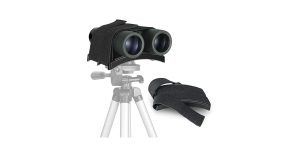
Here's the cleanest rule of thumb: a monocular becomes a spotting scope the moment you mount it on a tripod and zoom past 12x. Before that, it's a binocular alternative. After that, it's a scope.
The key is the tripod collar. Many high-power monoculars include a small rotating ring with a 1/4-inch thread. That socket snaps onto a standard tripod head.
A monocular built for this makes the transition smooth. A handheld-only monocular without a collar is harder to secure and won't balance well.
Stability changes everything. At 15x, the image is useful only when locked down. Birders remark that the same optics feel entirely different once still.
The reason you need a tripod above 12x has to do with natural hand tremor, typically about 1 to 2 degrees per second. Magnification amplifies each degree. A solid mount cancels that out completely.
In our research, most birders who tried a high-power monocular on a tripod ended up using it as their permanent scope. It saved money and backpack space. The flexibility to break it down and go hands-free was a bonus.
Expert Tips for Choosing Your One Optic
If you want a single instrument that straddles both worlds, follow these rules.
- Pick a monocular with a tripod collar. Without one, you're locked out of the spotting scope role later.
- Set a zoom ceiling of 20x to 24x. Anything higher needs a large objective lens and gets heavy.
- Test the eye relief. Eyeglass wearers need at least 15mm of eye relief to see the full field. Check manufacturer specs before buying.
- Verify waterproofing before trusting it outdoors. Condensation inside the lens ruins a trip fast. The IPX rating system gives you a clear standard.
- Budget for a small tripod. A lightweight tabletop model with a ball head costs $40 to $80 and transforms the monocular. It's the best value in birding optics.
Your final choice comes down to honesty about your habits. If you carry your optic for hours between sightings, prioritize weight. If you watch from one spot for hours, prioritize stability.
Do that math before you buy and you'll land on the right tool.
Real Scenarios: What Birders Actually Do
Picture a coastal marsh at dawn. A birder with a 10×42 monocular spots a sandpiper on a mudflat roughly 150 feet away. The bird is too distant to identify.
They mount a 15x zoom monocular on a lightweight tabletop tripod. The extra magnification reveals leg color and bill shape.
Now picture a forest hiker. They use an 8x monocular to track warblers in the canopy. In a clearing, they attach the same monocular to a monopod to watch a hawk migration.
Same optic, better stability, longer viewing sessions.
Picture a backyard birder near a feeder. A warbler lands 12 feet away. A spotting scope can't focus that close.
The monocular with a 6-foot close focus wins easily. That's why a lightweight monocular for nature walks fits so many birding styles.
These scenarios show the real deciding factor. It's not the label on the box. It's the distance you're viewing and whether you'll stay in one spot.
Frequently Asked Questions
At what magnification does a monocular need a tripod?
The practical starting point is 12x. At 10x, most people can hold steady for short views. At 12x, shake becomes noticeable.
At 15x and above, a tripod is essential for a usable image.
Can a monocular completely replace a spotting scope?
Not completely. A monocular can replace a scope for casual viewing and digiscoping up to about 25x. But for long-distance shorebird work or identifying rarities at 40x, a spotting scope with larger optics remains superior.
What is the best zoom range for a birding monocular?
An 8x to 24x zoom gives the best compromise. The low end offers a wide field for scanning. The high end provides enough reach for distant birds when you stabilize it.
Is a compact spotting scope worth it for birders?
Yes, for birders who regularly set up in one spot. Compact scopes in the 50mm to 60mm class are lighter than full-size models and easy to pack. For constant walkers, a tripod-mounted zoom monocular is often the better match.
How important is the tripod collar for high-power monoculars?
Very important. The collar provides a solid, balanced connection to the tripod head. Without it, a monocular may slip or refuse to stay oriented.
If you plan to use high magnification, buy a model with a rotating collar.
Final Verdict: What Should You Buy?
The honest answer is that it depends on how you bird. If you move constantly, prefer light packs, and see most birds under 100 feet, stick with a quality monocular. If you spend long sessions in one spot watching distant birds, invest in a compact spotting scope.
The gray zone is real, and the product label should not be your guide. Think about your typical outing. The backpack-friendly size and weight of a monocular often settles the argument by itself.
For most birders, the smart move is a high-power monocular with a tripod collar. It gives you flexibility. Use it handheld when you're moving.
Mount it when you need reach. Realistically, that one piece of gear covers both roles without forcing a choice.
The only wrong answer is buying a tool for the style of birding you don't practice. Buy for your actual habits in 2026, and you won't second-guess the label.