A sudden downpour rolls over the ridge. You pull your binoculars from your pack, wipe the rain from the objective lenses, and raise them to your eyes. Instead of a crisp view of a distant elk or a warbler in the canopy, you see fogged glass and water beading inside the housing. That moment is why waterproof ratings matter. For anyone who camps, hikes, or spends time near water, a binocular’s water resistance is not a luxury—it is the difference between a reliable tool and a fragile piece of glass.
The short answer: for most campers, IPX7 or JIS 7 is the sweet spot. That rating means the binoculars can survive accidental immersion in about one meter of water for 30 minutes, which covers rain, river crossings, and dropped-in-the-lake mishaps without making the binoculars unnecessarily heavy or expensive. But the full answer is more nuanced, and choosing the right rating depends on where you camp, how you travel, and what you expect your gear to survive.
This guide breaks down waterproof ratings in plain language, explains why fog-proofing and sealing matter just as much, and helps you match the rating to your real-world camping style.
Understanding Waterproof Ratings: IP vs. JIS
Before you buy, you need to understand the two main rating systems you will see on binoculars.
The IP Code (IEC 60529)
The International Electrotechnical Commission defines ingress protection (IP) ratings. An IP rating uses two digits: the first for dust protection (0–6), the second for water protection (0–8). The international standard for IP codes is used across electronics, outdoor gear, and optics, so it is a reliable reference. An “X” in place of a number—for example, IPX7—means the manufacturer did not test or rate dust protection. That is common on binoculars, because dust testing adds cost and many brands focus on water.
Common IP water ratings you’ll see:
| Rating | Protection level | What it means for camping |
|---|---|---|
| IPX4 | Splash-proof from any direction | Survives light rain briefly, not sustained exposure |
| IPX6 | Protected against powerful water jets | Handles heavy rain and spray, but not submersion |
| IPX7 | Immersion up to 1 meter for 30 minutes | The practical benchmark for most campers |
| IPX8 | Immersion beyond 1 meter (depth specified by maker) | For kayaking, canoeing, or prolonged submersion |
The JIS Scale (Japanese Industrial Standard)
Many binocular brands—especially those from Japanese and European optical houses—still use the older JIS scale. You will see markings such as “JIS Class 4,” “JIS Class 6,” or “JIS Class 7.” While not identical to IP, the practical equivalents are:
- JIS 4: splash-resistant, similar to IPX4. Fine for drizzle, risky in a downpour.
- JIS 6: resistant to strong water jets, comparable to IPX6. Good for steady rain.
- JIS 7: immersion-resistant to one meter for 30 minutes, comparable to IPX7. The realistic standard for serious outdoor use.
- JIS 8: rated for deeper or longer immersion, equivalent to IPX8.
In practice, when a binocular says “waterproof” without a specific code, assume it is splash-resistant only. When it says “waterproof and fogproof” with nitrogen purging, it usually meets at least JIS 4 or IPX6, and often better.
What IP Rating Do You Actually Need for Camping?
Your ideal rating depends on how water enters your life outdoors.
Casual car camping and fair-weather hikes
If you camp from a vehicle, mainly on maintained sites, and you can stash gear when rain starts, IPX4 to IPX6 will handle accidental splashes and short showers. You do not need to pay for submersion protection you will never test.
Backpacking and alpine terrain
Weight matters, but so does sudden weather. Mountain storms, stream crossings, and condensation from temperature swings make IPX6 or IPX7 the safer choice. A common mistake is buying a lighter splash-proof pair, then discovering that a river crossing soaked a pack compartment and killed the optics.
Kayaking, canoeing, fishing, or coastal camping
If your binoculars could plausibly fall into water, buy IPX7 or IPX8. Saltwater environments add corrosion risk, so look for models with fully sealed, nitrogen-purged bodies and corrosion-resistant metal components. The same pair that survives rain will not necessarily survive a dunk in a lake.
Winter and high-humidity camping
Frozen hands drop things. Snow melts into every crevice. Cold nights and warm tent air create internal fogging unless the binoculars are truly fog-proof. In these conditions, IPX7 plus internal nitrogen or argon purging is the minimum; IPX8 gives extra margin if you are near ice.
Bottom line: if you buy only one pair of camping binoculars and want them to handle 95% of real-world conditions, choose a model rated IPX7 or JIS 7 and verified as nitrogen-purged fogproof.
The Critical Difference: Waterproof vs. Fogproof
Waterproof and fogproof are not the same thing, and understanding the distinction will save you from a common and expensive disappointment.
A binocular can be waterproof on the outside but still fog internally. Fogging happens when humid air gets trapped inside the optical tubes and condenses on cold lenses during temperature changes. To prevent this, manufacturers purge the nitrogen-filled interior air and replace it with dry nitrogen or argon, then seal the body with O-rings. That internal gas displaces moisture-laden air, so there is nothing to condense.
That is why the best camping binoculars are described as “waterproof and fogproof.” The two features work together: the O-rings keep liquid water out, and the inert gas keeps internal condensation from forming. If a model is waterproof but not specifically labeled fogproof, assume you will see internal fogging the first cold morning after a humid day.
If you already own binoculars and struggle with fogging, learn how to prevent internal fogging and keep your view clear during temperature swings.
Beyond the Rating: Features That Keep Your View Clear
A waterproof rating tells you about water resistance, not optical quality or ergonomics. Before you buy, check these supporting features.
Fully multi-coated lenses
Multiple anti-reflective coatings on every air-to-glass surface improve light transmission and contrast, especially in low light at dawn and dusk. A waterproof body with cheap single-coated glass still delivers mediocre views. If you often glass in dim forest or twilight, a pair from the mid-range low-light category may outperform a waterproof brute with poor coatings.
Prism type
Roof-prism binoculars are slimmer, easier to seal, and dominate the camping market. Porro-prism models are bulkier but can offer excellent value. Both can be fully waterproof, but the roof-prism design makes a tighter, more compact sealed package. If you want to understand what that means for real-world use, this guide to roof-prism mechanics explains the trade-offs.
Rubber armor and grip
A thick rubber coating does two jobs: it absorbs shocks from drops and gives you a secure hold in the rain. Look for textured armor that stays grippy when wet. A slick body is a dropped pair waiting to happen.
Eye relief and eyecups
If you wear glasses, waterproofing does not help if you cannot get a full field of view. Look for at least 15–17 mm of eye relief and twist-up eyecups. The options for spectacle wearers prioritize long eye relief without sacrificing sealing.
Matching Ratings to Camping Styles: A Decision Table
Use this table as a quick reference when comparing models.
| Camping style | Minimum practical rating | Additional features to seek |
|---|---|---|
| Car camping, fair weather | IPX4 / JIS 4 | Budget-friendly, lightweight, good coatings |
| Backpacking, alpine | IPX6–IPX7 / JIS 6–7 | Nitrogen purged, low weight, rubber armor |
| Kayak, canoe, fishing | IPX7–IPX8 / JIS 7–8 | Corrosion-resistant body, floating strap |
| Winter, high humidity | IPX7 with fogproof purge | Argon or nitrogen filled, large focus wheel for gloves |
| Coastal, saltwater | IPX7–IPX8 plus anti-corrosion | Sealed metal parts, rinse after use |

Waterproof binoculars with rubber armor belong on every damp, misty campsite gear list.
Credit: www.fieldmag.com
Popular Waterproof Camping Binoculars by Budget
You do not need to spend a fortune, but you should know what each price tier buys you.
Budget (under roughly $150)
Expect IPX4 to IPX6 protection and basic multi-coated glass. These are fine for occasional campers who mostly stay in fair weather. Avoid models that claim “waterproof” without any rating code. If you take kids camping, the price range for children’s binoculars explains how far a small budget can go.
Mid-range (roughly $150–$500)
This is where IPX7 and full fogproof sealing become standard. You get better glass, phase-corrected prisms, and more durable armor. For hunting and all-weather use, weather-ready hunting optics in this tier deliver the best balance of performance and survival.
Premium (above $500)
Expect IPX7 or IPX8, argon purging, premium coatings, and lifetime warranties from brands with long reputations in sealed optics. These are overkill for a once-a-year camper but worthwhile if your binoculars are your primary outdoor tool year-round. If you are comparing established manufacturers, reputable roof-prism brands is a useful starting point.
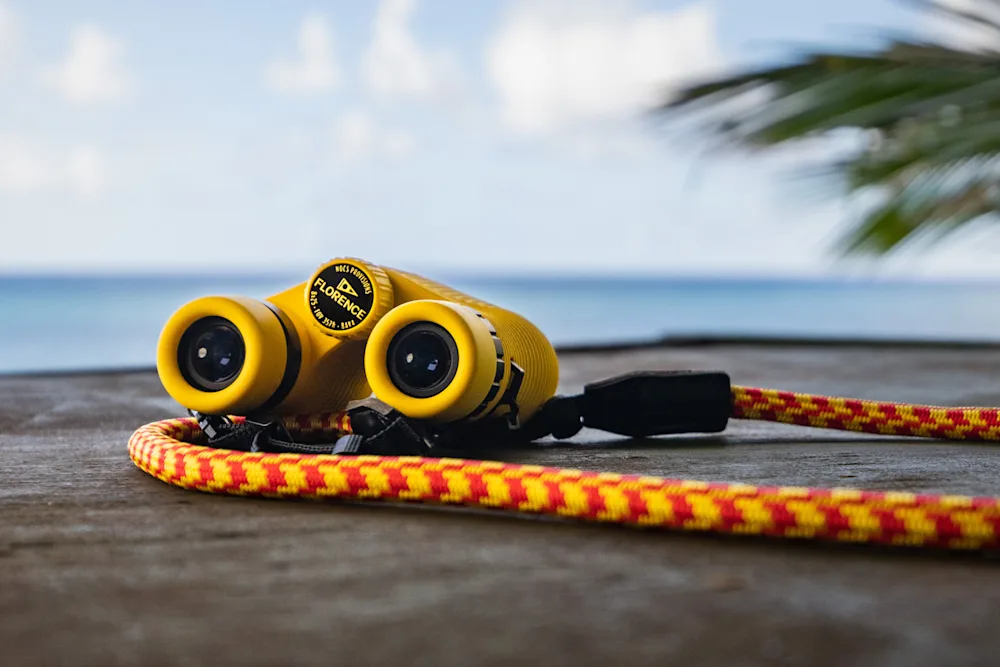
Sealed, fog-proof binoculars shrug off temperature swings and splashes around a busy camp kitchen.
Credit: www.fieldmag.com
Maintenance: How to Protect Your Waterproof Investment
Even the best-sealed binoculars need care, or the waterproofing degrades.
After every trip
- Rinse saltwater and sand immediately. Use fresh, lukewarm water—never hot—and avoid directing a strong jet at the seals. Pat dry with a microfiber cloth.
- Brush dust from crevices with a soft brush before wiping lenses, so grit does not scratch coated glass.
- Dry before storing. Leave the binoculars out in a warm, dry room overnight rather than sealing them damp inside a case.
Long-term care
- Store in a dry, padded case away from direct sunlight and extreme heat. Heat can soften seals and dry out O-rings over time.
- Keep lens caps on when not actively glassing. It reduces exposure of the exterior glass to rain, dust, and accidental bumps.
- Check the seals visually. Look for cracked or compressed O-rings around the eyepieces and focus wheel if your model allows access.
If your binoculars get wet beyond their rating or you notice internal fogging, do not assume they are ruined. Follow repair guidance for moisture-damaged optics before replacing them. For routine lens care, the same principles apply to all binoculars: learn how to care for coated lenses properly without stripping anti-reflective layers.
Common Myths About Waterproof Binoculars
“IPX7 means I can go diving with them.”
IPX7 is a short, shallow immersion test—30 minutes at one meter. It is not a diving or snorkeling rating. If your hobby involves going underwater, use a dedicated marine or submersible instrument.
“Waterproofing lasts forever.”
Seals and O-rings age, especially after years of heat, cold, and UV exposure. A binocular that was waterproof out of the box in 2019 may not be waterproof today. Treat older gear with more caution.
“Rubber armor means it’s waterproof.”
Rubber armor protects against shocks and improves grip. It says nothing about water resistance. A rubber-coated body can still leak around the focus wheel or eyepieces if not internally sealed.
“If it’s waterproof, I can leave it in the rain all trip.”
Waterproofing is for accidents and exposure, not storage. Prolonged soaking can still defeat seals, especially if water sits on the eyepieces. Wipe the binoculars down and store them dry when you are done for the day.
Frequently Asked Questions
What does “waterproof” mean on binoculars without an IP or JIS code?
It usually means the manufacturer claims some water resistance, often splash-proof at best. Without a specific rating, treat it as fragile in heavy rain and never submerge it. Look for a model that states IPX6, IPX7, or JIS 7 if you want certainty.
Is IPX7 enough for kayaking?
Yes, for accidental drops into shallow water and heavy spray, IPX7 is the practical minimum. If you paddle in rough conditions or saltwater, consider IPX8 and a binocular with corrosion-resistant construction and a floating strap.
Can waterproof binoculars fog up?
Yes. Waterproof only stops liquid water from entering. Internal fogging is prevented by nitrogen or argon purging. Always choose a model labeled both waterproof and fogproof for camping.
Do I need waterproof binoculars if I only camp in dry weather?
You still benefit from dust protection and resistance to morning dew, condensation, and the occasional spill. A splash-proof pair (IPX4) is enough, but waterproof and fogproof adds insurance for very little extra weight.
How do I know if my older binoculars are still waterproof?
Look for internal fogging after temperature changes, or have the seals inspected by a repair shop if the model is expensive enough to justify it. When in doubt, keep them out of serious water.

A fully multi-coated, waterproof roof-prism model is the modern standard for serious camping optics.
Credit: www.travelandleisure.com
Conclusion
For nearly every camper, the best waterproof rating is IPX7 or JIS 7—fogproof, nitrogen-purged, and built with rubber armor. It protects against the conditions that actually happen: rain, river crossings, wet packs, cold mornings, and accidental drops in shallow water. Going higher costs more and adds bulk; going lower leaves you vulnerable just when the weather turns.
Match the rating to your camping style, not to marketing hype. Car campers can save money with IPX6; paddlers and coastal campers should spend for IPX8 and corrosion resistance. Whatever you choose, pair the rating with good lens coatings, a comfortable grip, and routine maintenance, and your binoculars will stay clear for years.
If you are still deciding which model fits your needs, start with the basics of choosing your first serious pair, then narrow down by waterproof rating, weight, and budget. The rain will come—be ready to keep glassing through it.