Choosing binoculars for surveillance is not the same as choosing binoculars for birdwatching, stargazing, or hunting. You are often stationary for long periods, working in changing light, trying to remain discreet, and depending on the optic to reveal detail at distance without excessive shake.
The short answer: for most surveillance tasks, 7x to 10x magnification with a 35mm to 50mm objective lens is the practical sweet spot. A 10×42 or 8×42 roof-prism binocular is the closest thing to a default surveillance optic because it balances magnification, light gathering, weight, and field of view.
The longer answer depends on your environment, your distance from the subject, available light, and how long you need to observe.
In this guide, you will learn how to match binocular size and specifications to real surveillance conditions, avoid common mistakes, and choose an optic you can actually use comfortably for extended periods.

Credit: www.amazon.com
Why Binocular Size Matters More for Surveillance Than for General Use
In most outdoor hobbies, you can accept some compromise. In surveillance, the wrong size creates immediate practical problems.
A compact 8×25 is discreet and easy to carry, but it struggles at dusk. A 20×50 or larger optic shows more detail, but it is heavy, harder to hold steady, and far more visible. A 12x or 15x model may impress on paper but becomes difficult to keep on target during long observation sessions.
In practice, surveillance usually rewards moderation. The best binocular is the one you can hold without fatigue, aim quickly, and still use when light begins to fade.
The key is understanding how magnification, objective lens diameter, exit pupil, and physical size interact.
Understanding Binocular Numbers: 8×25, 10×42, 12×50
Every binocular is described by two numbers. The first is magnification. The second is the objective lens diameter in millimetres.
For example:
- 8×25: 8x magnification, 25mm objective lens
- 10×42: 10x magnification, 42mm objective lens
- 12×50: 12x magnification, 50mm objective lens
The objective lens determines how much light enters the binocular. Divide the objective lens diameter by the magnification and you get the exit pupil:
- 25 ÷ 8 = 3.1mm exit pupil
- 42 ÷ 10 = 4.2mm exit pupil
- 50 ÷ 12 = 4.2mm exit pupil
A larger exit pupil delivers a brighter image when your own pupils are dilated in low light. During daytime, your pupils may only be 2–3mm wide, so a compact binocular can still look reasonably bright. At dusk or in shadow, your pupils dilate wider, and the difference becomes obvious.
Magnification: Why More Power Is Often Worse
The Image Shake Problem
Higher magnification magnifies movement as much as it magnifies the subject. At 12x or 15x, small hand tremors become visible image movement. Without a tripod or image-stabilized binocular, many people cannot hold a 12x or higher optic steady enough for continuous detail work.
A common mistake is buying the highest magnification available and assuming it will improve observation. In practice, you often lose more detail to shake than you gain from power.
The Recommended Surveillance Range
For handheld use:
- 7x to 8x: Excellent stability, wide view, easy to use for long periods
- 10x: The upper practical limit for most handheld surveillance
- 12x: Usable for short looks, but generally benefits from support
- 15x or higher: Requires a tripod or stabilization for meaningful observation
For most people, 8x or 10x is the right range. It provides enough detail to read facial features, clothing, signage, or vehicle attributes without forcing you to fight the optic for stability.

Credit: www.amazon.com
Objective Lens Size and Low-Light Performance
Why Light Gathering Decides the Night
Surveillance rarely happens only at noon. Early morning, late evening, overcast weather, parking garages, and heavily shaded areas all reduce available light.
A bigger objective lens captures more light, but it also adds size and weight. The practical surveillance range is:
| Objective Lens | Light Gathering | Portability | Best Use |
|---|---|---|---|
| 25mm–28mm | Limited | Excellent | Daytime, discreet urban use |
| 32mm | Moderate | Good | Mixed daylight/shadow |
| 42mm | Strong | Good | General-purpose surveillance |
| 50mm | Very strong | Moderate | Twilight, distant observation |
| 56mm | Exceptional | Heavy | Low-light specialist work |
The 42mm Sweet Spot
A 10×42 or 8×42 delivers a 4.2mm or 5.25mm exit pupil respectively, which is enough for most low-light work before full darkness. It also remains compact enough to hold, pack, and brace against a window frame or vehicle edge.
If your work is mostly nocturnal, a 10×50, 8×56, or 7×50 will pull more detail out of low light. A 7×50 offers a 7.1mm exit pupil, which closely matches the fully dilated human eye, but it is bulkier and provides less magnification for identifying distant subjects.
Note that binoculars cannot create true night vision. In extreme darkness, you need night-vision equipment or illumination. Good optics help you see more in low light, but they do not turn darkness into daylight.
Field of View: What You See at a Distance
Field of view is the width of the area visible through the binoculars at a set distance, usually expressed in feet at 1,000 yards or metres at 1,000 metres.
Higher magnification almost always narrows the field of view. That matters during surveillance because you often need to:
- Track a moving person or vehicle
- Scan a wide area before focusing on one detail
- Pick up movement in peripheral vision
Wide vs Narrow in Practice
- Wide field of view helps you find and follow moving targets. It is more forgiving if the subject shifts position.
- Narrow field of view isolates detail once you have located the subject, but you can lose track of movement quickly.
An 8×42 typically offers a wider field than a 10×42, making 8x the better choice for scanning busy environments. A 10x gives a slightly tighter view but pulls the subject closer.
If you need both, look for a 10x model with a field of view at or above roughly 300 feet at 1,000 yards. Many modern roof-prism designs achieve this.
Balanced Magnification for Surveillance: A Practical Reference
| Specification | Workable | Better | Best for Most Use |
|---|---|---|---|
| Magnification | 7x–12x | 8x–10x | 10x |
| Objective lens | 25mm–56mm | 32mm–50mm | 42mm |
| Exit pupil | 2.5mm–7mm | 4mm–5mm | 4mm+ |
| Field of view | 250–400 ft | 280–350 ft | 300 ft+ |
| Weight | Under 40 oz | Under 30 oz | 20–28 oz |
There is no single perfect specification. The best choice matches the observation distance and light conditions you actually face.

Credit: www.amazon.com
Eye Relief: Critical If You Wear Glasses
Eye relief is the distance between your eye and the eyepiece where you still see the full image circle.
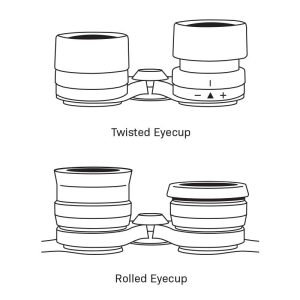
If you wear glasses, choose binoculars with at least 15mm to 17mm of eye relief. Models with twist-up or fold-down eyecups let non-glasses users seat the optic closer to the eye for a full view.
Short eye relief forces eyeglass wearers to press the glasses against the eyepiece, which reduces comfort and cuts off the edge of the image. That edge loss becomes especially annoying during long observation sessions.
For surveillance work where you may be wearing sunglasses or corrective lenses, eye relief is not a minor feature. A good option list for this specific need appears in this guide to choosing binoculars for spectacle wearers.
Weight, Grip, and Handling for Long Observation
Surveillance is different from a quick look at a bird. You may hold the optic for 30 minutes or more while waiting.
Heavier binoculars magnify arm fatigue. Once your arms tire, the image shakes and your attention shifts from the subject to your own discomfort.
Practical limits:
- Under 20 oz: Easy to hold for long periods
- 20–28 oz: Manageable for extended observation
- Over 32 oz: Noticeably tiring within minutes without support
In the field, the best position is rarely standing unsupported in the open. Brace your elbows on a windowsill, car mirror, wall, or bag. Even a basic support dramatically improves stability and reduces fatigue.
Look for a textured or rubber-armoured body that stays secure in one hand. A smooth metal finish looks refined but is harder to grip in humidity or rain.
Durability, Waterproofing, and Fogproofing
Surveillance equipment lives outdoors. Rain, humidity, dust, and sudden temperature changes are routine.
What to Look For
- Waterproof: Sealed with O-rings to prevent internal moisture and dust
- Fogproof: Purged with nitrogen or argon so internal lenses do not fog during temperature shifts
- Rubber armouring: Absorbs bumps and improves grip
Roof-prism binoculars are usually easier to fully seal than Porro-prism models because of their straight-barrel construction. If surveillance will involve vehicle-to-outdoor transitions, cold mornings, or coastal humidity, fogproofing is essential.
For an overview of optics designed to resist these conditions, see this breakdown of sealed, fog-resistant hunting binoculars.
Best Sizes for Specific Surveillance Scenarios
Urban and Close-Range Surveillance
In dense city environments, you are usually observing from nearer distances, often through windows or from parked positions.
Best choices:
- 8×25 or 10×25: Discreet, pocketable, adequate in daylight
- 8×32 or 10×32: Better low-light reach while still compact
An 8×25 fits in a jacket pocket and draws less attention. The trade-off is a dimmer image in shadows and a narrower exit pupil, which makes eye positioning more finicky.
Wildlife and Remote Area Monitoring
For open land, long sightlines, or observing wildlife without close approach, you need more reach and light.
Best choices:
- 10×42: The default all-round remote observation optic
- 10×50 or 12×50: More reach and twilight performance, but heavier
- 12×50 with a monopod or tripod: Best for static long-distance work
At longer distances, atmospheric haze, heat shimmer, and hand shake all reduce detail. Extra magnification only helps if you can stabilize the optic.
Security and Tactical Observation
Security work often mixes daytime and nighttime duties, rapid target acquisition, and extended waiting.
Best choices:
- 8×42 or 10×42: Versatile, bright, and durable
- 10×50: Strong low-light capability for perimeter work
- Image-stabilized 10x to 14x: Superior detail when observation must remain hands-free of a tripod
Many security teams prefer an 8×42 for scanning and a 10x for identification. If you can carry only one, the 10×42 is the safer generalist.
Image Stabilization, Night Vision, and Rangefinding
Image Stabilization
Image-stabilized binoculars use electronics or mechanical compensation to reduce shake. A stabilized 12x or 14x can deliver clearer handheld detail than an unstabilized 10x.
They are heavier, more expensive, and battery-dependent. For professional surveillance where identifying a subject at long range is critical, that trade-off is often worth it.
Night Vision
Optical binoculars only amplify available light. True night vision requires an intensifier tube or digital infrared system. Night-vision binoculars typically offer lower magnification, often 2x to 5x, and are judged by generation of image intensification rather than objective lens size alone.
Do not expect a standard 10×50 to work in full darkness. It will outperform smaller optics at twilight but cannot see without some light.
Rangefinding
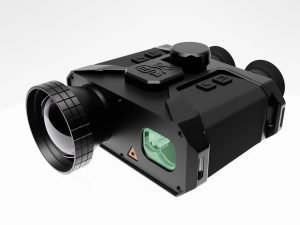
A laser rangefinder gives you accurate distance, which helps when reporting a subject's position or estimating travel time. Some binoculars integrate rangefinding, but they add cost, weight, and a battery requirement. Standalone rangefinding units often outperform integrated systems at a lower price.
How to Set the Binoculars Correctly for Surveillance
Even excellent optics perform poorly if not adjusted.
Step 1: Set the Interpupillary Distance
Fold or hinge the barrels until you see a single circular image instead of two overlapping circles.
Step 2: Adjust the Diopter
Most binoculars have a diopter adjustment on the right eyepiece. Close your right eye, focus the centre wheel on a distant subject using your left eye. Then close your left eye and adjust the diopter ring until the right eye sees the same sharp image. After this, use only the centre focus wheel.
Setting the diopter once at the start saves repeated refocusing and prevents eye strain. If you need a refresher on fast, repeatable focus technique, this method for getting birding binoculars sharp in seconds transfers directly to surveillance use.
Step 3: Brace the Optic
Sit against a stable object, rest your elbows, or support the objective lens end on a solid surface. Even a monopod improves long-duration clarity dramatically.
Cleaning and Maintaining Your Surveillance Optic
Dust, skin oil, and rain spots reduce contrast. A dirty lens can make a good binocular look like a cheap one, especially in low light when any film increases glare.
Basic care:
- Use a rocket blower or soft brush before wiping to remove grit
- Clean lenses with a dedicated lens cloth or solution, not a shirt sleeve
- Store in a dry, padded case
- Keep lens caps on when the binocular is not actively in use
For more detailed maintenance guidance when lenses become badly soiled, use this guide to dealing with damage and restoring clarity.
Budget vs Premium: What Actually Changes
Affordable Options
Under roughly $100–$150, you get serviceable roof-prism or Porro-prism binoculars suitable for daytime surveillance. Brands such as Nikon, Bushnell, and Celestron offer solid entry-level models.
Expect:
- Good centre sharpness
- Adequate but not exceptional edge sharpness
- Basic anti-reflective coatings
- Moderate low-light performance
- Simpler build quality
For casual or backup use, these are perfectly reasonable.
Premium Options
At higher price points from makers like Leica, Zeiss, and Swarovski, you are paying for:
- Superior lens coatings and higher light transmission
- Better edge-to-edge sharpness
- Tighter quality control
- More durable sealing and armouring
- Better resale value
The difference is most visible at dawn, dusk, and during long sessions. If surveillance is a regular or professional responsibility, the premium pays for itself in fewer missed details and less eye fatigue.
Choosing the Right Prism Design
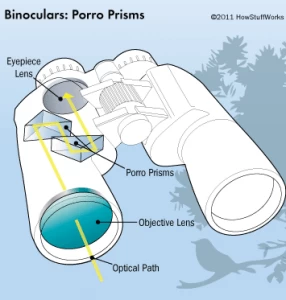
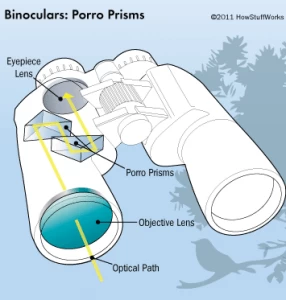
Most modern surveillance binoculars are roof-prism designs because they are slim, durable, and easy to waterproof. Porro-prism models can offer excellent optical value but are bulkier and less discreet.
If you want to understand why roof-prism optics dominate modern field work, this explanation of how roof-prism binoculars actually work covers the optical path in plain terms.
Common Surveillance Binocular Mistakes
Buying Too Much Magnification
This is the most frequent error. A 16x optic sounds powerful but becomes nearly useless handheld in fading light. Stick to 10x or lower unless you have dedicated support.
Ignoring Exit Pupil
A 10×25 has a 2.5mm exit pupil. In daylight that can work. At dusk, it produces a dim tunnel-like image that tires your eyes quickly.
Forgetting the Field of View
A narrow field makes scanning exhausting. If you need to monitor movement, prioritise field width over slight magnification gains.
Overlooking Diopter Setup
If one eye sees a soft image, you will unconsciously strain and miss detail. Set the diopter correctly on day one.
Choosing by Price Alone
A cheap high-magnification model often performs worse than a modest 8×42 from a reputable maker. Quality of glass and coatings matters as much as the specification sheet.
Frequently Asked Questions
What size binoculars are best for surveillance?
For most surveillance tasks, a 10×42 or 8×42 roof-prism binocular offers the best balance of magnification, brightness, weight, and field of view. In daylight-only urban work, an 8×32 can work well.
Are larger binoculars always better for night surveillance?
No. Larger objective lenses gather more light, but very large binoculars are heavy and hard to hold steady. A mid-size 10×50 often achieves better real-world low-light performance than an unwieldy 12×56 because the image is easier to keep still.
What magnification is best for detailed identification?
10x is usually the best compromise between detail and stability for handheld use. Higher magnification can help with a tripod or image stabilization, but handheld stability becomes the limiting factor.
Can I use compact 8×25 binoculars for professional surveillance?
In daylight and at shorter distances, yes. They are discreet and easy to carry. Their small exit pupil, however, limits useful observation in low light, and eye placement must be precise.
Should I choose roof-prism or Porro-prism binoculars?
Roof-prism models are generally better for surveillance because they are compact, durable, and easier to waterproof. Porro-prism models can be optically excellent but are bulkier and less discreet.
How important is fogproofing?
Very important if surveillance involves temperature transitions, cold mornings, rain, or humidity. A fogproof, nitrogen-purged body prevents internal lens fogging that would otherwise blur the view at the worst possible moment.
Conclusion
The best surveillance binocular is not the most powerful one. It is the optic you can hold steady, use in your working light conditions, and maintain without distraction.
For most observers, that means an 8×42 or 10×42 roof-prism binocular with fully multi-coated lenses, a wide field of view, waterproof and fogproof construction, and comfortable eye relief. If your work moves into deep twilight on a regular basis, step up to a 10×50. If discretion is paramount, a compact 8×32 can disappear into a jacket pocket while still offering useful daytime clarity.
Match the size to the scene, set the diopter correctly, brace the optic whenever possible, and keep the lenses clean. A good pair of surveillance binoculars rewards preparation far more than raw magnification.
If you expect to work in poor weather, start with a binocular that has weather-sealed, fog-resistant lenses as a baseline rather than an upgrade. For longer-distance identification, a dedicated spotting scope can complement a handheld 10×42 when you are observing from a fixed position.