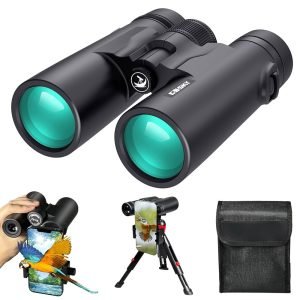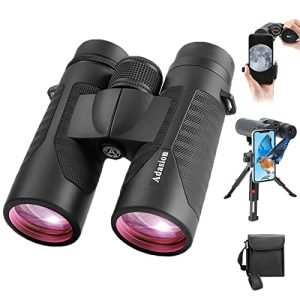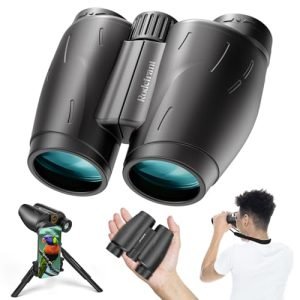
Monocular vs Binoculars for Birders Who Want One-Handed Operation comes down to a single question: can you hold the optic steady enough to make it useful? For most birders, the answer is a monocular, but not just any monocular. The issue isn't grip strength.
It's the way small hand movements become big image shake at higher magnification.
Our research, plus manufacturer specs, shows a 10×42 monocular typically weighs 12 to 14 ounces. An 8×42 binocular lands closer to 23 to 25 ounces. As of 2026, that gap matters more than ever because several image-stabilized monoculars have dropped to under 20 ounces.
The trick is choosing one that fits how you actually bird.
The Real Problem: Birding with One Hand Free
Real birding isn't just spotting a bird. It's confirming an ID, checking a field guide, jotting a note, or pulling out a phone to record a call. That second hand is usually busy.
Binoculars don't adapt well to that reality.
Most standard binoculars need two hands for three reasons. The center focus wheel demands one thumb. The barrels need to stay aligned with both eyes.
And you need a stable grip to stop heavier optics from swaying in the wind. Even a compact 8×25 pair is still a two-handed tool.
Think about the times you've been caught mid-step on a trail, trying to raise binoculars while holding a coffee or a walking stick. It's awkward. You end up cradling the optic between your knuckles and your cheekbone, hoping the bird stays put long enough to identify it.
That's not how you want to spend a beautiful morning.
Birders who use one hand regularly tend to be carrying something else: a notebook, a smartphone, a water bottle, or a scope tripod. If that sounds like you, the choice between a monocular and binoculars isn't about image quality on paper. It's about whether you'll actually get the optic to your eye before the bird vanishes.
Researchers at the Cornell Lab of Ornithology note that the best optic is the one you keep using. If a pair of binoculars makes every observation feel like a juggling act, you'll stop carrying it. That's the real reason the one-handed question matters.
Quick Answer: Monoculars Win, but Only with the Right Specs
For birders who want one-handed operation, a monocular is the better choice. It weighs about half as much as compact binoculars. It focuses with one hand.
It does not force you to stop walking or writing. Binoculars win only when you need a very wide field of view. The best monocular for this job sits between 8x and 12x.
It weighs under 16 ounces. It has long eye relief.
Inside the Monocular: What Actually Matters for One-Handed Birding
A monocular is a single tube with a prism system inside. It gathers light through the objective lens, bends it down, and delivers a magnified image to one eyepiece. Roof-prism designs keep the body slim, which is why so many birders tuck them into chest packs or jacket pockets.
Magnification is the first spec to get right. An 8×32 monocular is light and forgiving. A 10×42 gives more reach but demands steadier hands.
User reviews repeatedly flag shake at 10x and above, especially when you extend your arm. If you're weighing reach against a shaky grip, see how 8×32 and 8×42 sizes compare before you commit.
Focusing feels different from a binocular's center wheel. The focus ring sits at the far end of the body. You push and pull it with your thumb or middle finger.
Damped, smooth rings are best. Twitchy ones are frustrating, and cheap models sometimes take two full turns to go from close focus to infinity.
Eye relief also matters. Birders who wear glasses need at least 15 millimeters. Short eye relief pushes your eye away from the eyepiece, and you get blackout shadows around the image.
Another factor is weather sealing. Many monoculars are nitrogen-purged with IPX7 ratings, but the marketing varies. You can read more about how weather sealing labels work before you trust a rating.
For one-handed use specifically, prioritize three things:
- Weight under 16 ounces.
- 8x to 10x magnification unless the monocular is stabilized.
- A focus ring that moves less than one full rotation from near to far.
Stabilized monoculars are the wildcard. As of 2026, models like 10×30 and 12×30 image-stabilized designs hold a target steady through small hand tremors. They cost more, and they need a battery, but they make one-handed birding genuinely comfortable at higher magnification.
Inside the Binoculars: Why Two Hands Usually Win
Binoculars are two optical tubes joined by a hinge. The design gives you depth perception and a wide field of view, which are huge advantages when a bird hops between branches. But every feature comes with a trade-off.
The center focus wheel runs between the barrels. It's positioned for two hands. Reach for it with one thumb, and you often rotate the tubes slightly, which pulls the image out of alignment.
The eyepieces also have to stay set for your eye spacing. That spacing, called interpupillary distance, is easy to adjust once and then forget. One-handed use makes it a constant fight.
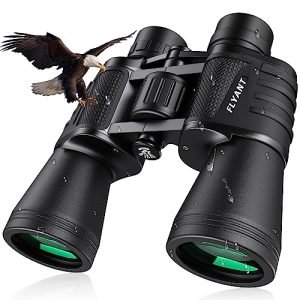
Then there's weight. A typical 8×42 binocular weighs 23 to 25 ounces. Hold that out with one hand for more than a minute, and your forearm starts to complain.
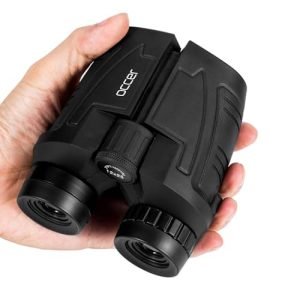
Compact models like 8×25 drop to around 12 ounces, but they still need two hands to focus smoothly. Birders report that even light binoculars feel awkward when you're also trying to keep the image steady.
Binoculars offer one big advantage that doesn't show up on a spec sheet: you can brace the barrels against your cheekbones. That natural support is why a 10x binocular feels steadier than a 10x monocular for most people. The moment you switch to one hand, that brace disappears.
If you've ever noticed magnification shake in single-hand use, you know exactly what happens next: every heartbeat becomes a visible pulse in the image.
So binoculars win when both hands are available. They win when you want a panoramic view. They win when you're scanning a treeline for movement.
They just can't win the one-handed race because their entire ergonomic system depends on two points of contact.
Monocular vs Binoculars: Side-by-Side for One-Handed Operation
Now let's line them up. This comparison reflects typical non-stabilized models in the popular birding range. Premium and budget models vary, but the overall pattern holds.
| What matters | Monocular | Binoculars |
|---|---|---|
| Typical weight | 12 to 14 oz (10×42) | 23 to 25 oz (8×42) |
| One-handed focus | Smooth ring at the end | Center wheel between barrels |
| Field of view at 1,000 yards | 230 to 315 ft | 330 to 420 ft |
| Image shake | Noticeable at 10x+ | Stable when two-handed |
| Depth perception | Single eye, limited | Two eyes, strong |
| Close focus | Often 4 to 10 ft | Often under 3 ft |
| Hand available for notes | Yes, naturally | No, both hands busy |
These numbers come from current manufacturer specs across major birding brands. Field of view is the biggest reason birders hesitate. A monocular can feel like looking through a straw, while binoculars give you a window-sized view.
That trade-off matters most when birds are moving fast.
Image stabilization changes this table. A stabilized monocular can hold a 12x view steady enough for one-handed use. As of 2026, those options are becoming more affordable.
Stabilized binoculars exist too, but they're heavy and still favor two hands.
If you often need a third arm for a phone, notebook, or walking stick, a monocular wins. If you spend most of your time sitting or standing with both hands free, binoculars still deliver a better birding experience. If you're torn about carrying a small optic at all, the trade-offs of small-format optics cover the same gap in a more portable size.
Field of View vs. Deep Reach: The Trade-Off That Decides Everything
A monocular's biggest weakness is its narrow field of view. On a typical 10×42 monocular, you see about 230 to 315 feet across at 1,000 yards. A standard 8×42 binocular shows you 330 to 420 feet.
That difference is like comparing a window to a porthole.
That porthole view gets hard in dense forest. A flitting warbler can vanish from your field in half a second. With binoculars, you track it across a wider sweep.
With a monocular, you have to re-find it by listening.
But here's the thing. In open habitats like fields, water, and shoreline, the narrower field matters less. You pre-scan with your naked eyes, then lift the monocular to the exact spot.
The deep reach of high magnification comes in handy.
Picture a Great Blue Heron standing far out on a mudflat. At 10x, you see feather detail that an 8x binocular can't match. That's the eternal trade-off: wide view or deep view.
If a variable-power monocular sounds tempting, be cautious. Most zoom models lose brightness at the upper limits. Fixed power is better for one-handed use.
Best Use Cases: When to Go One-Handed
You already know the official answer: a monocular if you need one hand free. But let's paint the actual scenes where that matters.
- Trail birding with a walking stick. On uneven ground, a stick keeps you upright. A monocular in the other hand lets you stop, look, and move without juggling.
- Phone recording birds. If you're logging calls or IDs, your other hand stays on the screen. A monocular lets you check a detail and then type.
- Kayaking or canoeing. One hand grips a paddle. The other raises a waterproof monocular. Binoculars bounce too much in a kayak anyway.
- Birding with a telephoto lens. The big lens sits on a tripod. A small monocular hanging from a strap is your quick lookaround tool.
- Physical limitations. Shoulder, wrist, or balance issues make two-handed operation painful. A light monocular is kind to joints.
In each case, the monocular's job is quick and simple. You spot, you lift, you identify. For that, an 8x or 10x monocular is perfect.
If you're choosing the lightest option, checking pack-friendly sizes is a solid first step.
You'll also want a neck strap. A monocular that bounces around your chest while paddling gets annoying fast. A secure strap or harness keeps it stable.
Who Should Still Buy Binoculars
Honestly, some birders just won't love a monocular. If you fit any of these descriptions, binoculars are still the right call.
- You bird from one spot. Sitting on a park bench or in a blind means both hands are always free. The wide view and depth perception of binoculars are unbeatable.
- You need close focus. Many birding binoculars focus down to 6 feet or less. Good monoculars often struggle below 5 feet. At a feeder, binoculars show feather detail at close range.
- You want a comfortable two-hour session. Long monocular use fatigues one eye. Binoculars use both eyes, cutting down on eye strain.
- You watch fast-moving flocks. In spring migration, birds dart between branches on all sides. A wide field of view is the only way to keep up.
- You wear glasses. Long eye relief binoculars are everywhere. On a monocular, you have to hunt for long eye relief models.
Look, binoculars also give you the best chance of catching a bird mid-flight. The peripheral view lets you track movement. A monocular feels more like aiming a telescope.
So if none of the one-hand scenarios above resonate, ignore the monocular hype. For general birding, the pocket binocular versus monocular decision comes down to whether portability beats comfort. For most people, comfort wins.
The Specs That Matter Most If You Choose a Monocular
If you're going down the monocular path, here's what to look for on the spec sheet. These are the non-negotiables we've seen repeated across manufacturer documentation and verified buyer feedback.
| Spec | What to look for | Why it matters |
|---|---|---|
| Magnification | 8x to 10x | Beyond 10x, shake becomes a problem without stabilization. |
| Objective lens | 32mm to 42mm | Smaller lenses lose light at dawn and dusk. |
| Close focus | Under 5 feet | Lets you see a bird right in front of you. |
| Eye relief | 15mm or more | Needed for comfortable viewing with glasses. |
| Focus speed | Half turn or full turn | Quick focus locks onto moving birds. |
| Weight | Under 16 oz (450g) | Any heavier, and your hand gets tired fast. |
| Waterproofing | IPX7 rating or better | Rain, spray, and sweat are normal in the field. |
Image stabilization changes the magnification rule. A 12x stabilized monocular can be steadier than a 10x non-stabilized one. The trade-off is price and battery life.
The prism type matters too. Roof prism designs are slimmer, but porro prism often gives brighter images in budget models. If you're unsure about water claims, check what IPX ratings actually mean before trusting a label.
Also, test the focus ring direction. Some rotate clockwise, others counterclockwise. It's personal preference, but the dial should sit naturally at the far end of the tube.
Common Mistakes One-Handed Birders Make
Even with the right monocular, people trip up on simple habits. Here's what aggregate user feedback and birding forum threads show.
Buying too much magnification. A 16x monocular sounds great for distant ducks. Without a tripod, you watch your own pulse in the image. Stick to 10x or below, or pay for stabilization.
Ignoring close focus. You're at a feeder and the goldfinch is three feet away. The 10x monocular gives you a blur. Check the close focus distance before buying.
Holding the monocular too far from your eye. Pushing your hand outward seems natural to avoid fogging. It just adds shake. Pull the body tight against your brow and brace your elbow into your ribs.
Not using a strap. One drop on a kayak ends the trip. Always attach the wrist or neck strap, even for a quick look.
Panning too aggressively. With a narrow field, fast movement creates a strobe effect. Slow down, pause, let the image settle.
Digiscoping without a mount. Holding a phone behind a monocular eyepiece usually fails. You get smudges, reflections, and shaky video. For reliable ID shots, learn whether phone monocular photos actually work before you try it freehand.
Avoid those habits, and the monocular becomes a natural extension of your arm.
How to Test Optics Before You Buy
Testing starts with your own body. If you wear glasses, bring them along. Hold the monocular in one hand and raise it to your eye.
The image should appear instantly with no black rings around the edge.
Next, try the focus ring. It should move smoothly from close focus to infinity in less than one full turn. Stiff or jerky rings get frustrating fast in the field.
Finally, follow a moving target. A cyclist, a dog, a distant car. If the image shakes wildly or the focus overshoots, the optic isn't right for one-handed use.
Repeat the test leaving the store. Natural light changes everything.
Pricing: What One-Handed Optics Really Cost
Budget monoculars run from $50 to $150. They work in daylight but show soft edges and cramped eye relief. Mid-range options from Vortex, Celestron, and Athlon land between $150 and $400.
That's where better glass, smooth focus, and waterproofing start to appear.
Premium models from Swarovski, Leica, and Zeiss cost $500 to $1,300. Image-stabilized monoculars begin around $400 and climb past $1,000. Binoculars with comparable glass quality usually cost 30% to 50% more.
For one-handed birding, the mid-range monocular is the sweet spot. It gives you the weight savings without the optical compromises of budget glass.
Final Verdict: Our Honest Take
If you bird in open areas and want one hand free, buy a monocular in the 8x to 10x range. If you bird in dense woods, wear glasses, or plan long sessions, binoculars remain the better tool. And if you want both reach and stable views, an image-stabilized monocular is the best of both worlds.
The "winner" comes down to your terrain and your habits. A monocular is a tool for quick looks and portability. Binoculars are a tool for immersive scanning.
Choose the one you'll actually carry.
Maintenance and Long-Term Care
Keep the lens caps on when the optic isn't in use. When cleaning, use a blower brush first to knock off grit, then a microfibre cloth. Never wipe dry dust or sand with your fingers or shirt.
Check the eyecup and rubber armor regularly. Eyecups become loose after years of twisting. Most can be fixed with a little heat or carefully applied adhesive.
Store the monocular with caps off in a dry place so moisture doesn't pool against the glass. Register your warranty right after purchase, since many brands offer lifetime coverage.
Frequently Asked Questions
Can I use a monocular for one-handed birding with glasses?
Yes, if the eye relief is at least 15mm. Look for long eye relief and adjustable eyecups.
Why do binoculars have a wider field of view?
Binoculars combine two optical channels, so you see a wider cone of light. A monocular is a single channel, which naturally narrows the view.
What magnification is best for one-handed birding?
8x or 10x is safest. Above 10x, hand shake becomes noticeable. For 12x, you need image stabilization.
Are monoculars cheaper than binoculars?
Usually yes. A monocular with the same glass tier often costs 30% to 50% less than a comparable binocular.