Choosing the right magnification for tactical binoculars isn’t about buying the highest number you can find. In practice, most experienced operators, hunters, and prepared civilians discover that the “best” magnification is the one that balances detail, stability, field of view, and low-light performance for the specific environment you work in. Too much magnification can make a binocular nearly unusable without a tripod; too little can leave you unable to identify a target at distance.
This guide breaks down exactly how magnification affects real-world performance, what ranges work for different mission profiles, and how to pair magnification with objective lens size and optical quality. By the end, you’ll know precisely which specification to prioritise—and which ones to ignore.
Why Magnification Isn’t the Only Number That Matters
Many buyers fixate on magnification first, but it’s only one part of a three-number system. A binocular marked “10×42” tells you it magnifies ten times and has a 42mm objective (front) lens. The second number matters just as much for brightness and steadiness.
A high-magnification binocular with a small objective lens produces a dim, shaky image. A lower-magnification binocular with a large objective lens can feel brighter and easier to use for hours. Before we dive into the recommended magnification ranges, you need to understand the trade-offs clearly.
Understanding Binocular Numbers: 10×42, 8×32, and What They Really Mean
The first number is magnification—how many times closer an object appears compared to the naked eye. The second is the objective lens diameter in millimetres. A 10×42 binocular magnifies ten times and gathers light through a 42mm lens.
A third number, exit pupil, is calculated by dividing the objective diameter by the magnification. For a 10×42, that’s 4.2mm. In bright daylight your eye’s pupil is around 2–3mm, so a 4.2mm exit pupil provides plenty of light. In deep twilight, your pupil dilates to 5–7mm, and a 10×42 starts to feel dim compared with an 8×56 (7mm exit pupil). This relationship explains why magnification cannot be chosen in isolation.
For a deeper explanation of how roof prism optics work and why they dominate modern tactical binoculars, see how roof prism binoculars function.
| Specification | 8×42 | 10×42 | 12×50 |
|---|---|---|---|
| Magnification | 8x | 10x | 12x |
| Objective diameter | 42mm | 42mm | 50mm |
| Exit pupil | 5.3mm | 4.2mm | 4.2mm |
| Typical field of view at 1,000m | ~120–130m | ~100–110m | ~80–90m |
| Hand-hold steadiness | Excellent | Good | Fair—tripod recommended |
The Core Trade-Offs of Tactical Magnification
Every magnification choice is a compromise. Understanding these four trade-offs will save you from buying an optic that looks impressive on paper but fails in the field.
Field of View vs. Detail
Higher magnification narrows your field of view. At 8x, you might see 400 feet across at 1,000 yards; at 12x, that drops to roughly 270 feet. For scanning terrain, tracking a moving person or animal, or maintaining situational awareness, a wider field wins. For identifying a licence plate or facial features at long range, more magnification helps—but only if you can hold the optic steady.
A common mistake is choosing 12x or 15x binoculars for “all-purpose” tactical use, then discovering you cannot find a target quickly because you’re looking through a soda straw.
Image Stability and Hand Tremor
Magnification amplifies every small movement in your hands. An 8x binocular exaggerates hand shake about eight times; a 12x exaggerates it twelve times. In practice, most people can hold 7x to 8x steady enough for extended observation. At 10x, you’ll notice a pulse-induced bounce. At 12x and above, a tripod, monopod, or braced position against a tree or vehicle becomes almost mandatory for detailed work.
If you struggle to keep a binocular steady, learning proper focusing technique reduces the frustration. See this guide on focusing birding binoculars quickly for methods that transfer directly to tactical glass.
Low-Light Performance
Dawn, dusk, and overcast conditions are when many tactical and hunting situations occur. As magnification increases, brightness drops unless you also increase the objective lens size. An 8×56 is a night-capable optic with a 7mm exit pupil; a 10×42 is brighter than a 12×50 despite the lower magnification because the 12×50’s exit pupil is smaller.
If your work regularly extends into low light, prioritise exit pupil over raw magnification. This article on low-light hunting binoculars explains how to evaluate brightness for dawn-and-dusk use. For wet or humid environments, waterproofing and fog-proofing become equally critical—see weather-sealed binoculars for hunting.
Weight and Endurance
Higher magnification usually requires larger objective lenses and heavier prism assemblies. A 12×50 can weigh 35–40 ounces or more, while an 8×32 may weigh under 20 ounces. Over a full day of carrying, scanning, and holding the optic to your eyes, that difference becomes severe neck and shoulder fatigue. Tactical use often involves other gear—plates, packs, rifle—so every ounce matters. If you’ll be hiking long distances with the optic, consider how it will be carried and accessed. Learn more about carrying binoculars comfortably while hiking.
 Credit: gununiversity.com
Magnification Ranges and When to Use Them
4x to 6x: Close-Quarters and Rapid Scanning
Low magnification in the 4x–6x range delivers an extremely wide field of view and superb stability. These optics are light, fast, and easy to hold steady even while moving. They are ideal for dense woodland, urban rooms and corridors, or any scenario where targets are close and speed of acquisition matters more than fine detail.
Trade-off: you sacrifice long-range identification. At 100 yards, a 6x makes a person look only six times larger—fine for spotting, poor for reading details.
7x to 8x: The All-Purpose Workhorses
This is the sweet spot for most tactical users. An 8×42 or 7×50 balances magnification, exit pupil, field of view, and weight. You can hold it steady for long periods, scan quickly, and still identify a human figure at several hundred yards. Most professional binoculars used by law enforcement and military units fall into this range for exactly these reasons.
In practice, 8x is often described as the highest magnification you can comfortably hand-hold all day without support. If you can only own one tactical binocular, an 8×42 or 8×56 is the strongest default choice.
10x: Long-Range Observation with a Steady Hand or Support
Ten-power optics bring more detail to mid- and long-range observation, but they demand better technique. The field narrows, shake increases, and low-light brightness drops unless you step up to a 50mm objective. For surveillance from a concealed, braced position, or for hunting open country, a 10×42 or 10×50 can be excellent. For extended handheld scanning, many users find 10x tiring after a few minutes.
12x and Above: Tripod Territory
At 12x and beyond, hand-holding becomes impractical for detailed work. These magnifications are best suited to fixed observation posts, vehicle-mounted use, or dedicated long-range glassing with a tripod. In fast-moving tactical scenarios, they are usually a liability because of the narrow field and slow target acquisition.
How Objective Lens Size and Optical Quality Change the Equation
Exit Pupil and Low-Light Performance
As covered above, divide objective lens diameter by magnification to get exit pupil. For bright daylight, a 3–4mm exit pupil is adequate. For twilight, look for 5mm or more. A 7×50 and an 8×56 both deliver a 7mm exit pupil, making them excellent low-light tools. A 10×42 delivers 4.2mm—usable at dusk but not ideal.
If low-light performance is a priority, choose a 7×50 or 8×56 rather than chasing magnification. This principle holds true whether you’re hunting, observing wildlife, or conducting nighttime surveillance. The same optical rules guide astronomers choosing binoculars for stargazing—see this guide on using binoculars for stargazing for a detailed explanation of exit pupil in practice.
Glass, Prisms, and Coatings
Magnification means little if the glass is poor. Fully multi-coated lenses and phase-corrected roof prisms dramatically improve light transmission, contrast, and colour fidelity. A high-quality 8×42 can outperform a cheap 10×50 in clarity and brightness because superior coatings recover light that budget optics lose through reflection.
When evaluating any binocular, look for “fully multi-coated” (all air-to-glass surfaces coated) and “phase-corrected” prisms. These features add cost but they are the difference between a dull, low-contrast image and a crisp, bright one. Major optics manufacturers publish extensive educational resources on lens coatings and prism design—Zeiss, for example, explains these engineering choices in depth on its consumer optics site.
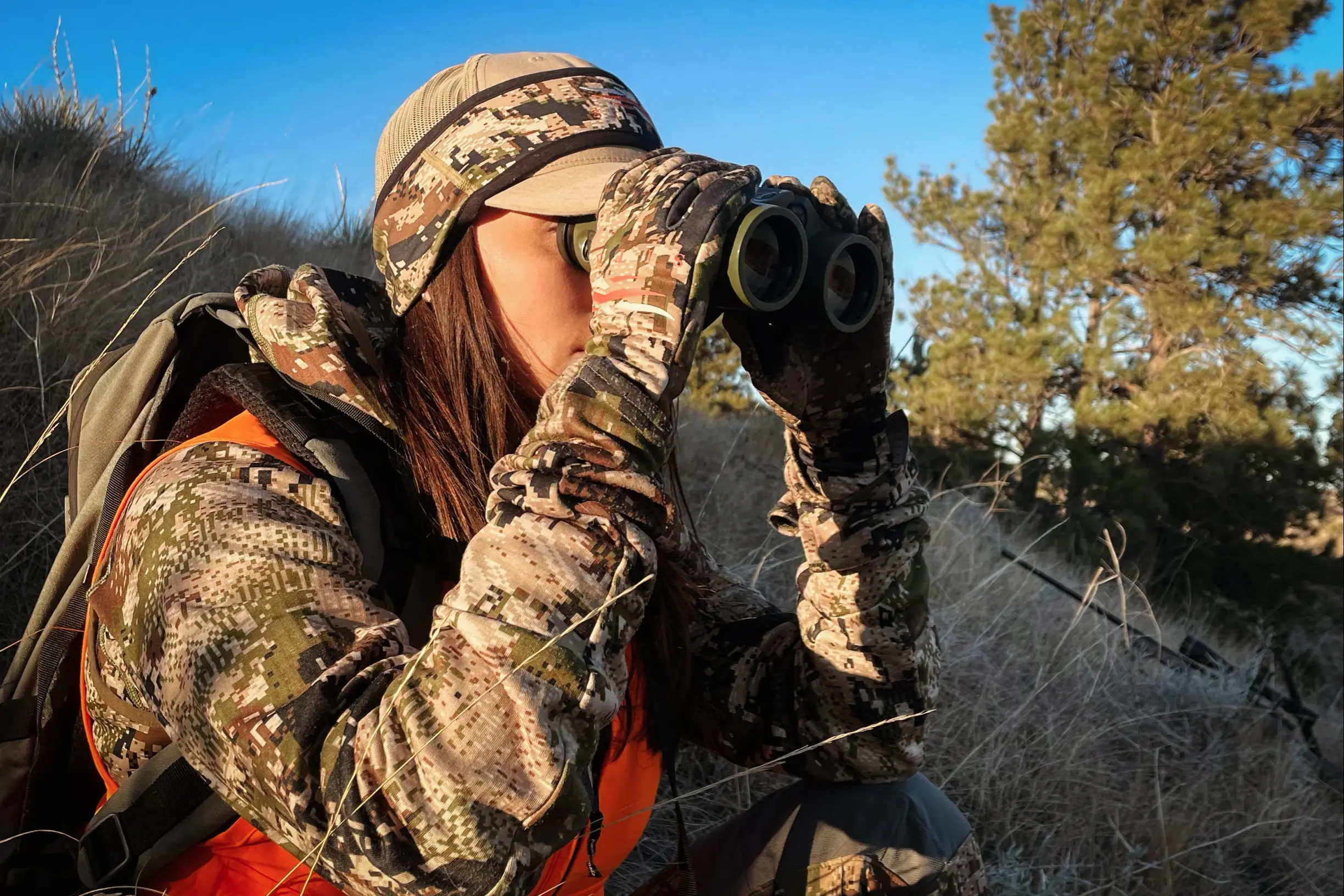 Credit: gearjunkie.com
Real-World Tactical Scenarios and Recommended Setups
Different environments favour different magnifications. Here’s how experienced users typically match optics to mission profiles.
Urban Operations
Buildings, streets, and dense infrastructure limit engagement distances. A 5x–8x binocular with a wide field is ideal for scanning windows, doorways, and alleys quickly. Look for a compact, lightweight roof-prism design that won’t snag on gear. An 8×32 or 7×35 is a common choice.
Woodland and Rural Terrain
Mixed forests and rolling fields require flexibility. Distances range from 25 to 300 yards, and light is often filtered by canopy. An 8×42 is the strongest all-rounder here: wide enough to find movement in brush, strong enough to identify deer or human figures at 200–300 yards, and bright enough for dawn and dusk.
Maritime and Open Terrain
Deserts, plains, and open water demand more reach. With no cover and long sight lines, a 10×50 or 12×50 on a tripod or braced against a vehicle excels. The larger objective lenses also help in the glaring, high-contrast light of open environments. However, if you must carry the optic for miles, a 10×42 is a more practical compromise.
Vehicle-Mounted or Stationary Observation
Tripod-mounted or vehicle-supported work removes the stability penalty of high magnification. Here, 12x, 15x, or even 20x becomes viable. Pair these with 50mm or larger objectives and a sturdy mount. This is the only context where high magnification genuinely pays off for sustained observation.
| Scenario | Recommended Magnification | Objective Size | Notes |
|---|---|---|---|
| Urban / close quarters | 5x–8x | 32–42mm | Fast target acquisition, light weight |
| Woodland / mixed terrain | 8x | 42mm | Best all-round balance |
| Open plains / maritime | 10x–12x | 42–50mm | Use brace or tripod |
| Stationary / vehicle-mounted | 12x–20x | 50mm+ | Tripod required for detail |
 Credit: www.camouflage.ca
Matching Magnification to Mission: A Practical Decision Guide
To choose the right magnification, answer these five questions in order:
- What is the typical distance to target? Under 100 yards favours 5x–7x. 100–400 yards favours 8x. Over 400 yards favours 10x or more.
- Will you be moving or stationary? Moving and handheld favours 7x–8x. Stationary and braced allows 10x–12x.
- What light conditions dominate? Daylight allows smaller objectives. Dawn, dusk, or night requires 50mm+ and lower magnification.
- How long will you glass? Hours of handheld use demands lower magnification and lighter weight. Brief checks allow heavier high-power optics.
- What else are you carrying? Add the binocular’s weight to your total load. A 40-ounce optic is a burden over a full mission.
If your answer to most questions points toward balance, an 8×42 is almost always the right call. If you need more reach but still want handheld use, move to a 10×42 and accept the trade-offs. Only choose 12x or higher if you have a dedicated, supported observation role.
Common Mistakes to Avoid When Choosing Tactical Binoculars
- Buying the highest magnification available. More power sounds better but it usually means a dimmer, shakier, slower optic in the field.
- Ignoring the objective lens diameter. A 10×25 binocular is far less useful than an 8×42 for anything but bright daylight.
- Overlooking eye relief. If you shoot with glasses or eye protection, you need at least 15–17mm of eye relief to see the full field. See binoculars for glasses wearers for more guidance.
- Skipping weather sealing. Fogged lenses at the wrong moment ruin an observation. Prioritise nitrogen-purged, O-ring-sealed optics, especially in humid or cold climates.
- Not maintaining the optic. Dirt, dust, and moisture degrade image quality and shorten lifespan. Routine cleaning and care keep performance intact—this guide to cleaning and maintaining coated lenses explains the correct technique, and it applies to adult tactical glass as well.
- Assuming magnification substitutes for quality. Cheap high-power binoculars produce soft, low-contrast images. Better glass at 8x beats mediocre glass at 12x every time.
Final Recommendations: The Best All-Round Magnification
For the vast majority of tactical, hunting, and preparedness applications, 8x is the best magnification, paired with a 42mm or 50mm objective lens. An 8×42 offers the best balance of steady image, wide field, bright exit pupil, light weight, and all-day comfort. It is fast enough for close work and strong enough for positive identification at several hundred yards.
If you operate primarily in open terrain and can brace the optic, a 10×42 or 10×50 is a strong second option. Reserve 12x and above for tripod-supported observation posts. Below 7x, you gain speed and stability but lose critical detail at range.
Frequently Asked Questions
What magnification do military forces actually use?
Most issued military binoculars are 7x or 8x, often with 40–50mm objectives. The priority is a wide field, durability, and a steady handheld image—not extreme magnification. Some specialised observation roles use higher power, but infantry and reconnaissance units overwhelmingly favour 7x–8x.
Is 10x too much for handheld tactical use?
Not always, but it requires good technique. A 10×42 is usable handheld for short periods, especially with a cheek weld or braced position. For extended scanning, most users experience noticeable shake. If you choose 10x, practice steady holds and consider a monopod.
Can I use a rifle scope’s magnification as a comparison?
No. Rifle scopes often run 4–14x because they are supported by the firearm and used for aimed shots. Binoculars are handheld scanning tools with different ergonomic and stability limits. A 10x binocular feels harder to hold steady than a 10x rifle scope.
Are zoom binoculars a good tactical choice?
Variable-magnification binoculars offer flexibility but add weight, complexity, and often sacrifice optical quality at the extreme ends. They are not commonly issued for tactical use. A fixed-power 8x or 10x is simpler, more durable, and optically superior at its magnification.
Conclusion: Your Next Steps for Choosing the Right Optic
Start with an 8×42, then adjust only if your mission profile demands otherwise. Prioritise fully multi-coated lenses, phase-corrected prisms, and at least 15mm of eye relief. Choose an objective size that matches your light conditions—50mm for twilight, 42mm for general use, 32mm for close-range speed.
Once you have the right magnification, proper care extends its service life. Learn how to repair damaged binoculars so a minor impact doesn’t end a mission-critical tool. If you’re also selecting optics for a young observer, choosing the right magnification for kids follows the same principles at a smaller scale.
The best tactical binocular is the one you can hold steady, carry all day, and trust in bad weather. Choose for balance, not for the biggest number on the box, and your optic will serve you far longer than any high-power marketing gimmick.