A binocular can be the single most useful tool in your observation kit — if it is the right one. Whether you are watching a property line, scanning a crowd, checking a distant vehicle, or working security at night, the optics you choose decide how much you actually see.
The 2026 market has changed. Image stabilization is more affordable, compact roof-prism binoculars are brighter than ever, and digital night vision is no longer a specialist-only gadget. That makes picking a pair harder, not easier.
This guide cuts through the specs and tells you exactly what matters for surveillance, which categories deserve your money, and how to test a pair before you commit.
What Makes a Binocular Suited to Surveillance?
A general-purpose binocular is fine for ten-minute looks. Surveillance is different: prolonged holding, fast target acquisition, low-light work, and a hard life in pockets or vehicles. Four qualities separate a true observation tool from a toy.
Magnification: the 7x–12x Sweet Spot
Most serious surveillance work happens at 8x or 10x. These powers offer enough reach to read a face, a vehicle, or a sign across a field, while staying steady enough to hold by hand.
At 12x and above, image shake becomes obvious, and this is where the most common surveillance buying mistake appears — the belief that more zoom is always better. In practice, a 12x binocular that you cannot hold steady shows less detail than a 10x model you can. Use high powers only from a stabilized mount, a vehicle rest, or with an image-stabilized optic.
Objective Lens Size and Low-Light Ability
The objective lens is the big glass at the front. Its size controls how much light reaches your eye.
- 42mm is the surveillance standard. It balances brightness, weight, and cost.
- 50mm and larger excel at dawn, dusk, and shadowed areas but add noticeable bulk.
- 25–28mm compacts are fine in daylight but struggle when the light drops.
The number that tells the real story is the exit pupil: divide the objective size by the magnification. A 10×42 gives 4.2mm. An 8×42 gives 5.25mm. At night, your pupils dilate to roughly 7mm, so a larger exit pupil produces a visibly brighter image. That is why 8×42 and 7×50 models have a reputation as twilight performers.
Field of View and Tracking
Field of view (FOV) is how wide an area you can see at a set distance, usually expressed as feet at 1,000 yards or metres at 1,000 metres. For surveillance, it determines how quickly you can find a target and stick with it as it moves.
A narrow field is like looking through a straw: you pick up the target, then lose it the moment it shifts. For a detailed breakdown of what to look for, check our explanation of the ideal scanning width. The short version — favour a wide field for scanning open ground, and accept a narrower field only when you need maximum reach.
Lens Coatings and Prism Glass
Lens coatings reduce glare and reflection and increase light transmission. You will see several terms on spec sheets:
- Coated — one layer on some lens surfaces. Better than nothing.
- Fully coated — at least one layer on every air-to-glass surface.
- Multi-coated — multiple layers on some surfaces.
- Fully multi-coated — multiple layers on every surface. This is the one to insist on.
Prism quality matters just as much. Roof-prism binoculars should list phase-correction coatings, which preserve contrast and sharpness. For prism glass, BAK-4 delivers a brighter, rounder image than the cheaper BK-7. If a listing is vague about coatings, treat that as a warning. Hunters and hikers who demand maximum clarity consistently choose multi-layer optical coatings for good reason.
Eye Relief: Critical If You Wear Glasses
Eye relief is the distance between your eye and the eyepiece where you can still see the full image. If you wear glasses, you need roughly 14–15mm or more; otherwise, you will constantly battle a tunnelled view.
Comfort also extends beyond fit. Long observation sessions strain the eyes, especially in flat, low-contrast light. Eye-care specialists recommend the 20-20-20 rule to reduce fatigue: every 20 minutes, look at something 20 feet away for 20 seconds. It works as well behind binoculars as it does behind a screen.
Build Quality, Weatherproofing, and Weight
Surveillance gear lives outside. You need:
- Nitrogen-purged, O-ring-sealed construction — this is what "waterproof and fogproof" actually means.
- Rubber armour — protects the body and gives a secure grip in rain.
- A drop-tolerant design — optics get knocked, and a solid build survives it.
Weight is the hidden spec. A 42mm binocular typically weighs 650–850g, and after two hours on a neck strap you will feel every gram. If your work involves walking patrols or long vehicle shifts, compare wet-weather optics and drop-tested armour before you settle on a pair.
Top Picks for Surveillance Binoculars
There is no single "best" surveillance binocular, only the best for your environment. These five categories cover the realistic options in 2026, with honest trade-offs.
Best Overall: A Quality 10×42 Roof Prism
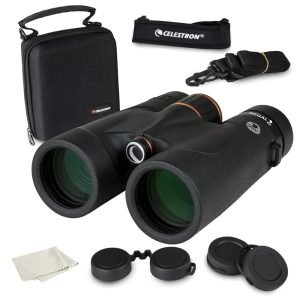
A 10×42 roof-prism binocular is the default choice for most surveillance roles. It reaches far enough for practical observation, stays bright in marginal light, and remains comfortable for extended carry.
Look for a fully multi-coated model with phase-corrected BAK-4 prisms, roughly a 110m field at 1,000m, and a weight under 750g. You do not need the most expensive glass on the market — a solid mid-tier 10×42 outperforms a premium 12x that you cannot hold steady.
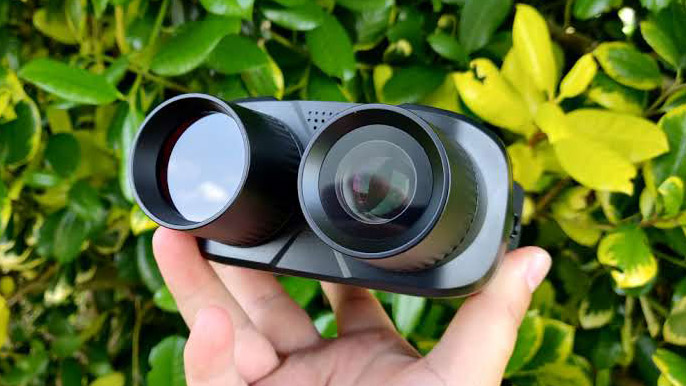
Credit: www.digitalcameraworld.com
A 10×42 roof-prism binocular — the format most surveillance users settle on.
Best Budget: An 8×40
If your budget is tight, an 8×40 is the smart buy. The 40mm objective keeps the image bright, and the 8x power is forgiving of hand shake, which suits beginners and quick observational checks.
Budget models usually cut costs on coatings and build, not on basic usability. Check that the listing says at least "fully coated" and be sceptical of any unlabelled lens treatments. For better clarity, an 8×42 is worth the small price jump.

Credit: www.amazon.com
Entry-level 8×40 models keep costs low while preserving a bright, wide image.
Best Compact: An 8×25
When a binocular must live in a glovebox, a daypack, or a jacket pocket, an 8×25 is the practical answer. These are genuinely pocketable, weigh around 300–400g, and are perfect for daytime security checks or discreet observation.
Expect compromises. The smaller objective struggles in low light, and the view is noticeably dimmer than a 42mm at dusk. For close-to-mid-range daytime work, though, many lightweight, packable designs perform far better than their size suggests.

Credit: www.amazon.com
An 8×25 compact model slides into a pocket for quick daytime checks.
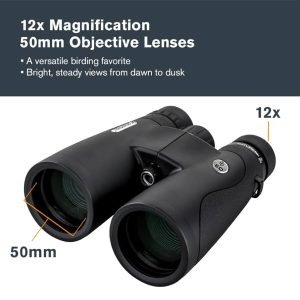
Best Low-Light: A 10×50 or 12×50
For dawn, dusk, and deeply shaded ground, a 50mm objective is the honest answer. It gathers the light that 42mm lenses cannot, and it pairs naturally with watching animals in open terrain — the same conditions that apply to fence lines, car parks, and field perimeters.
Heavier and bulkier than a 42mm, these are best used from a fixed position. A 10×50 remains hand-holdable for most people; a 12×50 really wants a tripod or vehicle mount.
One more low-light factor is you, not the binocular. Vision scientists such as those at the National Eye Institute note that dark adaptation takes roughly 20 to 30 minutes. If you move between well-lit and dark areas, give your eyes time to adjust before trusting what you see.
The Stabilized Option: 12x and Beyond
Image-stabilized binoculars have dropped in price and weight, and they genuinely solve the shake problem. A stabilized 12x or 14x lets you read fine detail at long range without a tripod, and it excels from moving platforms like boats or vehicles.
The trade-offs are real: higher cost, battery dependency, and extra weight. If you spend most of your time scanning static scenes from one location, a conventional 10×42 is the better investment.
Key Specs at a Glance
| Category | Magnification | Objective | Typical FOV | Weight | Best For |
|---|---|---|---|---|---|
| Best overall | 10x | 42mm | ~110m @ 1,000m | 650–750g | All-round surveillance |
| Budget pick | 8x | 40mm | ~120m @ 1,000m | 550–650g | Daytime checks, beginners |
| Compact | 8x | 25mm | ~100m @ 1,000m | 300–400g | Pocket carry, travel |
| Low light | 10x–12x | 50mm | ~90–100m @ 1,000m | 850–1,000g | Dawn, dusk, fixed posts |
| Stabilized | 12x–14x | 42mm | ~80–90m @ 1,000m | 700–900g | Long-range hand-held use |
Which Brands Make the Best Surveillance Binoculars?
Brand reputation matters less than a specific model's coatings, build, and warranty — but it narrows your search quickly.
Premium European manufacturers such as Zeiss, Leica, and Swarovski produce exceptional glass with industry-leading light transmission. You pay heavily for that final few percent of performance, and for many surveillance roles it is genuinely hard to see the difference in daylight.
Mid-tier brands including Vortex, Nikon, and Bushnell offer the best value for most people: strong coatings, solid weatherproofing, and warranties that cover real-world damage. Their mid-priced 10×42 models are the default recommendation for professional users who need reliable equipment without a prestige price tag.
The overlap between security and observation is strong — the same most reliable optics brands appear across both fields. A useful rule: check the warranty before you check the logo. A long, transferable warranty tells you more about a manufacturer's confidence than any marketing claim.
How to Test Any Binocular Before You Buy
Spec sheets lie less than you think, but your own eyes are still the best test. Use these four checks before handing over money.
1. The hand-shake test. Hold the binocular to your eyes and keep a small distant sign centred for 30 seconds. If the image floats and wanders, the power is too high for your hands.
2. The edge test. Look at a vertical pole or a roof edge near the edge of the view. If it shows blue or purple fringing, the unit has chromatic aberration — common on cheap glass.
3. The dusk test. Compare two binoculars side by side in fading light. The brighter, more contrasty image wins, regardless of what the spec sheet claims.
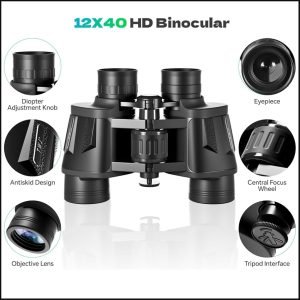
4. The comfort test. Adjust the diopter, extend the eyecups, and hold the pair for five minutes. A binocular that pinches your nose, presses your glasses, or feels front-heavy will end up sitting in a drawer.
These checks take ten minutes and will prevent the two most common buying mistakes: overpowered zoom and a dim, narrow view.
Maintenance That Keeps Your Optics Reliable
Surveillance binoculars fail most often through neglect, not use.
- Clean lenses in the right order. Blow off loose dust with a blower, brush away the rest, then wipe with a microfibre cloth. Pressing dirt into glass with a shirt sleeve is the quickest way to scratch a lens.
- Store them dry. Use the lens caps and keep the binocular in a breathable case with a silica gel packet. Prolonged damp storage invites fungus on the glass.
- Check the moving parts. The centre focus and diopter ring should turn smoothly. If they stiffen, a tiny amount of silicone grease is better than forcing them.
- Inspect the strap. A snapped neck strap at head height is one of the most common causes of binocular damage.
Frequently Asked Questions
What Magnification Is Best for Surveillance?
For almost all surveillance work, 8x or 10x is best. Ten power gives the reach to identify people and objects across large areas; eight power is more forgiving in low light and easier to hold steady. At 12x and above, image shake becomes a serious limitation unless you use a tripod or a stabilized model.
Is a 10×42 or 8×42 Better for Surveillance?
A 10×42 provides more detail at distance and is the better all-rounder. An 8×42 provides a wider field, a brighter image in twilight, and steadier hand-held viewing. If you work mostly in daylight and need reach, choose 10×42. If you work at dawn, dusk, or in shaded conditions, choose 8×42.
Do I Need Night Vision Binoculars for Surveillance?
Only for genuinely dark conditions. Digital night-vision devices add cost, weight, and battery dependency, and their resolution usually falls well short of a conventional glass view. For most users, a quality 10×50 or 8×42 with good lens coatings is the more practical investment. True night vision is a different category, not an upgrade.
Can Compact Binoculars Handle Surveillance Work?
Yes, for daytime and close-to-mid-range work. An 8×25 is ideal for discreet carry and quick checks, but its small objective lens will disappoint in low light. Match the binocular to the time of day you actually observe — that is the fastest way to avoid disappointment.
How Important Is Field of View?
More important than magnification for tracking moving targets. A wide field lets you find a subject quickly and follow it as it moves through buildings, trees, or crowds. If you are choosing between a high-zoom model and a wide-field model, test the wide-field one first — most observers prefer it in real use.
Conclusion
The best surveillance binocular for 2026 is the one that matches your conditions: 10×42 for general use, 8×40 if budget is the priority, 8×25 for pocket carry, and 10×50 or 12×50 for low light. Insist on fully multi-coated lenses, BAK-4 prisms with phase correction for roof models, waterproof construction, and enough eye relief for your eyes or glasses.
Then test it the way you will actually use it — hand-held, at distance, and in fading light. Start with a fully multi-coated 10×42 from a trusted brand; it is the shortest path to a surveillance tool you will reach for every day.