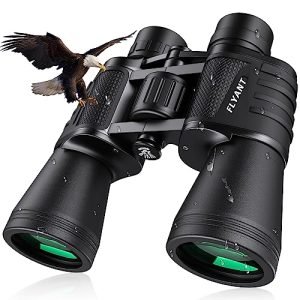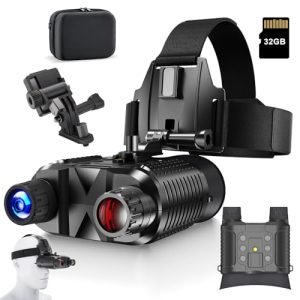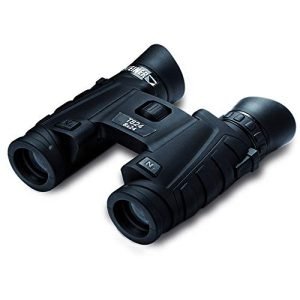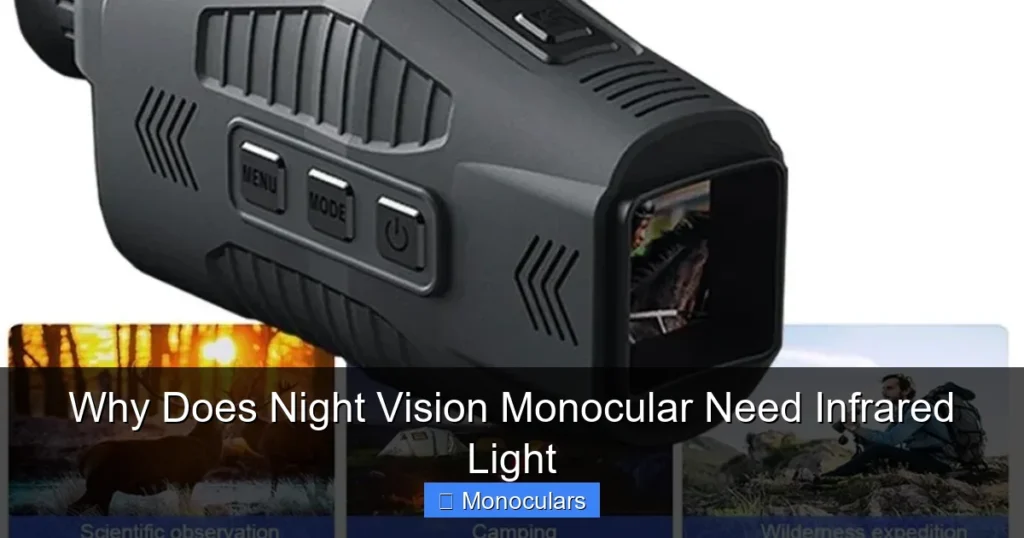
Night vision monoculars need infrared (IR) light because they rely on available ambient light to create images—and in total darkness, there’s none. Infrared illumination fills this gap by emitting invisible light that the device can detect and amplify. This allows users to see clearly in pitch-black conditions without being detected.
Key Takeaways
- Infrared light provides illumination in total darkness: Without any visible light, night vision devices can’t function—IR fills this void by emitting non-visible light.
- IR is invisible to the human eye and most animals: This makes it ideal for stealth operations, wildlife observation, and security surveillance.
- Night vision monoculars amplify existing light: They work by collecting ambient light (moonlight, starlight), but IR boosts performance when that light is insufficient.
- IR enhances image clarity and range: Built-in or external IR illuminators improve detail and allow viewing at greater distances in complete blackout.
- Different generations of night vision use IR differently: Higher-gen devices are more sensitive and may require less IR, but still benefit from it in extreme low-light scenarios.
- IR helps avoid detection: Since IR light isn’t visible to the naked eye, using it keeps your presence hidden from others.
- Modern monoculars often include built-in IR illuminators: This makes them more convenient and effective for nighttime use without extra gear.
📑 Table of Contents
- Understanding How Night Vision Monoculars Work
- Why Infrared Light Is Essential in Total Darkness
- The Role of IR in Enhancing Image Quality and Range
- Stealth and Detection: The Covert Advantage of IR
- Types of Infrared Illuminators and How They Work
- Practical Tips for Using IR with Your Monocular
- Common Misconceptions About Night Vision and IR
- Conclusion: Why IR Is a Night Vision Game-Changer
Understanding How Night Vision Monoculars Work
Night vision monoculars are incredible tools that let you see in the dark—something the human eye simply can’t do on its own. But how do they actually work? At their core, most night vision devices, including monoculars, rely on a process called image intensification. This means they collect tiny amounts of available light—like moonlight, starlight, or even ambient urban glow—and amplify it thousands of times to create a visible image.
Think of it like turning up the volume on a whisper. The monocular’s objective lens gathers whatever light is present, then passes it through an image intensifier tube. Inside this tube, photons (light particles) strike a photocathode, which converts them into electrons. These electrons are then accelerated and multiplied through a microchannel plate, creating a much stronger signal. Finally, the electrons hit a phosphor screen, producing the green-hued image you see through the eyepiece.
But here’s the catch: if there’s absolutely no light—like in a deep forest at midnight or inside a dark building—there’s nothing for the monocular to amplify. That’s where infrared light comes in.
Why Infrared Light Is Essential in Total Darkness
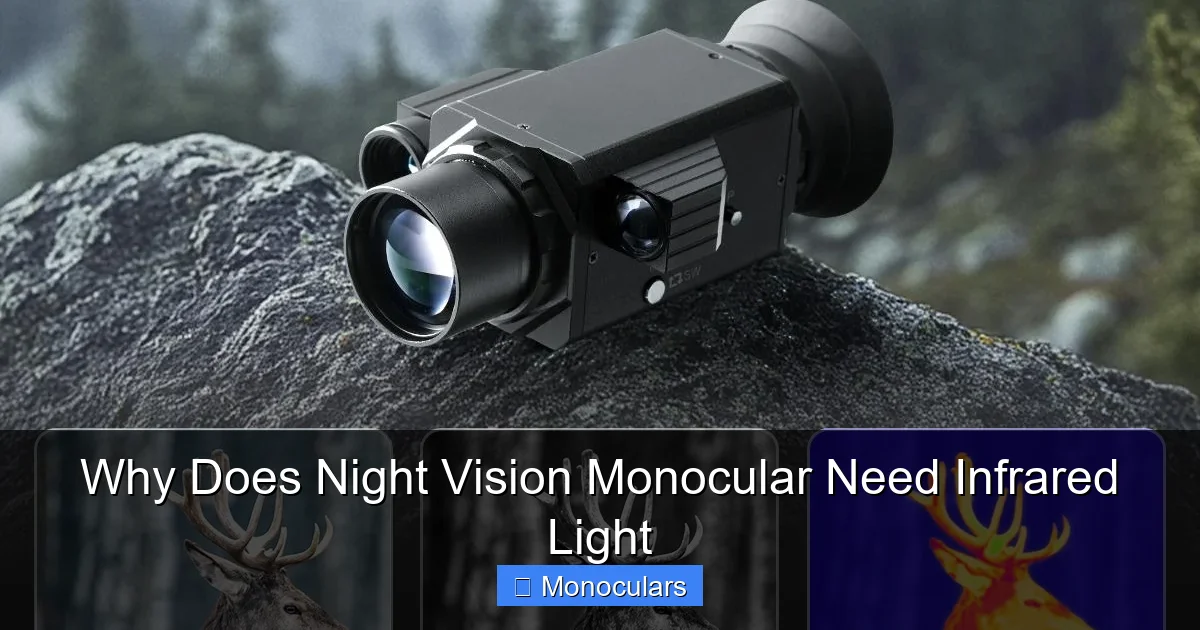
Visual guide about Why Does Night Vision Monocular Need Infrared Light
Image source: img.kentfaith.com
In perfect darkness, even the most advanced night vision monocular hits a wall. No ambient light means no photons to convert into electrons. Without that initial input, the entire image intensification process grinds to a halt. This is why infrared (IR) light is not just helpful—it’s essential.
Infrared light sits just beyond the visible spectrum, with wavelengths longer than red light. While we can’t see it, many electronic sensors—including those in night vision devices—can detect it. An IR illuminator, either built into the monocular or attached externally, emits this invisible light into the environment. The monocular then picks up the reflected IR light just like it would with visible light, allowing it to create a clear image even when it’s pitch black.
For example, imagine you’re camping in a remote area with no moon and heavy cloud cover. Your night vision monocular might struggle to produce a usable image. But turn on the IR illuminator, and suddenly, you can see the trail ahead, animals in the distance, or potential hazards—all without anyone (or anything) knowing you’re watching.
The Role of IR in Enhancing Image Quality and Range
Infrared light doesn’t just make night vision possible in total darkness—it also improves the quality and reach of what you see. Without IR, images in low-light conditions can appear grainy, blurry, or lack detail. Adding IR illumination fills in shadows and enhances contrast, making objects easier to identify.
Improved Detail and Contrast
When IR light bounces off objects, it provides additional data for the monocular to process. This results in sharper edges, better texture definition, and more accurate depth perception. For instance, distinguishing between a tree branch and a camouflaged animal becomes much easier with IR support.
Extended Viewing Distance
The power of the IR illuminator directly affects how far you can see. A weak IR beam might only light up objects within 50 yards, while a high-powered one can illuminate targets over 200 yards away. This is especially useful for hunters tracking game or security personnel monitoring large perimeters.
Many modern monoculars come with adjustable IR brightness, allowing you to tailor the illumination to your environment. In open fields, you might crank it up for long-range viewing. In dense woods, a lower setting prevents overexposure and maintains stealth.
Stealth and Detection: The Covert Advantage of IR
One of the biggest benefits of using infrared light with a night vision monocular is stealth. Because IR is invisible to the human eye—and to most animals—it allows you to observe without being seen. This is a game-changer for wildlife photographers, military personnel, and security professionals.
Undetectable Surveillance
Imagine you’re on a night hike and spot a rare nocturnal animal. Using a flashlight would scare it away. But with IR illumination, you can watch and record its behavior without disturbing it. Similarly, law enforcement or security teams can monitor suspects or intruders without revealing their position.
Reduced Risk of Exposure
In tactical situations, visibility can mean the difference between success and failure. Traditional flashlights or headlamps give away your location. IR light, however, remains hidden unless someone is also using night vision gear. This gives you a significant tactical advantage.
Even among animals, IR is rarely detected. Most mammals and birds can’t see into the infrared spectrum, so using IR won’t spook deer, raccoons, or owls. This makes it ideal for ethical wildlife observation and hunting.
Types of Infrared Illuminators and How They Work
Not all IR illuminators are created equal. Understanding the different types can help you choose the right setup for your needs.
Built-In IR Illuminators
Many modern night vision monoculars come with integrated IR lights. These are convenient because they’re always with you—no extra gear to carry or batteries to manage. They’re typically low to medium power, suitable for short to medium-range viewing (up to 100 yards). Some models even allow you to adjust the intensity or switch between wavelengths (like 850nm or 940nm).
External IR Illuminators
For longer range or more powerful illumination, external IR illuminators are the way to go. These attach to the monocular or a rail system and can project IR light over 300 yards. They’re commonly used by hunters, search and rescue teams, and military units. While they add bulk and require separate power, their performance is unmatched in extreme conditions.
Wavelength Matters: 850nm vs. 940nm
IR illuminators emit light at different wavelengths, measured in nanometers (nm). The two most common are 850nm and 940nm.
– 850nm: Offers brighter illumination and better image quality but emits a faint red glow visible to some people and animals. Best for short-range use where stealth isn’t critical.
– 940nm: Completely invisible, making it ideal for covert operations. However, it requires more power and may reduce image brightness slightly.
Choosing between them depends on your priority: visibility or stealth.
Practical Tips for Using IR with Your Monocular
Getting the most out of your night vision monocular and IR setup requires more than just turning it on. Here are some practical tips to maximize performance:
- Match IR power to your environment: Use lower settings in close quarters to avoid washout. Increase power for open areas or long-range viewing.
- Check battery life: IR illuminators drain power quickly. Always carry spare batteries, especially on extended trips.
- Clean the lens and IR emitter: Dust, moisture, or fingerprints can reduce effectiveness. Use a microfiber cloth and lens cleaner regularly.
- Avoid pointing IR at reflective surfaces: Windows, water, or shiny objects can cause glare or hotspots. Angle the beam slightly if needed.
- Practice in different conditions: Test your monocular with IR in various environments—forests, fields, urban areas—to understand its limits and strengths.
- Use a head mount for hands-free operation: This is especially helpful for hunters or security personnel who need to move quietly and keep their hands free.
Common Misconceptions About Night Vision and IR
Despite their popularity, night vision monoculars and infrared light are often misunderstood. Let’s clear up a few myths:
- Myth: Night vision works in total darkness without IR. Fact: Without any light—visible or IR—most monoculars can’t produce an image. IR is essential in pitch-black conditions.
- Myth: IR light is harmful or dangerous. Fact: The IR used in monoculars is low-power and safe for eyes and skin. It’s not the same as thermal imaging or laser weapons.
- Myth: All night vision devices use thermal imaging. Fact: Most consumer monoculars use image intensification, not thermal. Thermal detects heat, while IR provides illumination for light-based systems.
- Myth: IR gives you “superhuman” vision. Fact: While powerful, IR has limits. Weather, fog, and dense foliage can reduce effectiveness.
Conclusion: Why IR Is a Night Vision Game-Changer
Infrared light is the unsung hero of night vision technology. Without it, night vision monoculars would be useless in the very conditions they’re designed for—complete darkness. By emitting invisible light that the device can detect and amplify, IR bridges the gap between total blackout and clear visibility.
Whether you’re a hunter tracking game under the cover of night, a camper navigating a dark trail, or a security professional monitoring a perimeter, IR illumination gives you the edge you need. It enhances image quality, extends range, and keeps you hidden from sight.
Modern monoculars with built-in IR make this technology more accessible than ever. With the right setup and a few smart practices, you can unlock the full potential of night vision—turning the dark into a world of clarity and opportunity.
So the next time you head out after sunset, remember: it’s not just about having night vision. It’s about having the right light to see with.
Frequently Asked Questions
Can night vision monoculars work without infrared light?
Yes, but only if there’s some ambient light—like moonlight or starlight. In total darkness, they need infrared illumination to function. Without IR, there’s nothing for the device to amplify.
Is infrared light visible to the human eye?
No, infrared light is invisible to humans. However, some IR illuminators (especially 850nm) may produce a faint red glow that’s barely noticeable in very dark conditions.
Do animals see infrared light?
Most animals cannot see infrared light. This makes IR ideal for wildlife observation and hunting, as it won’t disturb or alert animals to your presence.
Can I use a regular flashlight instead of an IR illuminator?
No, a regular flashlight emits visible light, which can ruin your night vision and give away your position. IR light is invisible and safer for stealth use.
How far can an IR illuminator reach?
It depends on the power. Built-in IR illuminators typically reach 50–100 yards, while high-powered external models can illuminate targets over 300 yards away.
Do I need special batteries for the IR illuminator?
Most IR illuminators use standard batteries like AA or CR123A. Always check your monocular’s manual and carry spares, as IR drains power quickly.