A golf ball leaves the clubface at speeds that can exceed 150 mph, climbs against a bright sky, then drops toward a fairway that may be 200 or 250 yards away. Tracking that entire journey with the naked eye is difficult. Tracking it with the wrong pair of binoculars is arguably worse — you end up staring at a tiny, shaky circle of grass while the ball lands somewhere you cannot see.
That is exactly why field of view matters more for golf optics than almost any other specification. A pair that frames too little course will have you constantly searching, while a pair that frames a broad sweep of the hole makes spotting the ball, the flagstick, and your playing partners feel almost effortless.
This guide explains what field of view actually means, the ideal range for golf, how it trades off against magnification, and how to choose a pair you will actually enjoy carrying for 18 holes.
What Field of View Actually Means
Field of view (FOV) is how much of the scene appears inside the eyepiece at a given distance. In optics marketing, it is usually written one of two ways:
- Linear FOV: feet visible at 1,000 yards (e.g., 341 ft @ 1,000 yds)
- Angular FOV: degrees of visible arc (e.g., 6.5°)
They describe the same thing from different angles. Linear FOV is easier to picture on a golf course because it translates directly to ground coverage far away. Angular FOV is more useful when comparing different magnifications head-to-head.
In practice, a wider linear FOV means you spend less time sweeping the binoculars side to side to locate a small white ball against a huge landscape. A narrow FOV delivers a tighter, more zoomed-in view but demands that you already know precisely where to look.
The standard for measuring binocular field of view follows optomechanical specifications established by industry bodies like Optica, and manufacturers publish these figures on spec sheets. Learn to read them, because two 8x binoculars can differ in usable viewing width by 20 percent or more.
Why Field of View Is the Defining Spec for Golf
Other applications reward maximum magnification. A birdwatcher sitting still can live with a narrow view and a tripod. A golfer is standing on uneven turf, the ball is moving fast, and the target is small.
Field of view directly affects three things on the course:
- Ball tracking: once the ball descends beyond 130–150 yards, most golfers lose it visually. A wide FOV catches more of the flight path so you can reacquire the ball before it lands.
- Course awareness: hazards, tree lines, mounding, and group positions in front of you all matter. A narrow view blinds you to context.
- Stability: steadier hands are needed as magnification climbs. A wider field at lower magnification feels calmer and easier to hold on target.
Common wisdom in the optics community is that a narrow-but-sharp view beats a wide-but-soft view only if you are stationary. Golf is the opposite of stationary.
The Sweet Spot: 315 to 400 Feet at 1,000 Yards
The most useful field of view for golf binoculars sits between 315 and 400 feet at 1,000 yards, typically paired with 6x to 8x magnification.
That is not an arbitrary range. It balances three competing demands:
- Enough width to follow a moving ball and see a green complex framed by its surroundings
- Enough magnification to identify the flagstick position, ball lie, sand surface, and course markings
- Enough stability to use the binoculars standing up, without a tripod or monopod
Field of View Ranges at a Glance
| FOV (ft @ 1,000 yds) | Experience on the Course | Best For |
|---|---|---|
| Under 300 ft | Tunnel-like view; you must already know where the ball is | Stationary spotting, rangefinder hybrids |
| 315–340 ft | Comfortable, stable, easy to find fast-moving balls | Most golfers: the practical sweet spot |
| 340–400 ft | Expansive, forgiving view; easiest to acquire targets | Senior players, shaky hands, crowded courses |
| Over 400 ft | Very wide but often soft at the edges or low magnification | Broad landscape viewing, not fine detail |
A common mistake is assuming more field of view is always better. Beyond roughly 400 feet, manufacturers usually achieve the width by dropping magnification or using simpler eyepiece designs, and edge sharpness often suffers. For golf, the middle of the table is where the money is.
Field of View vs. Magnification: The Trade-Off You Cannot Escape
Optic physics imposes an unavoidable relationship: higher magnification narrows the field of view, and lower magnification widens it.
- 6x binoculars commonly deliver 390–420 ft FOV. You see almost the whole hole at once, but the flagstick looks small at 200 yards.
- 8x binoculars typically land around 330–360 ft FOV. This is the golf default: enough detail, enough width.
- 10x binoculars often drop to 280–320 ft. The zoom is tempting, but handheld shake becomes obvious, and you lose the ball more often.
For most players, 8x is the ceiling worth considering without a monopod. If your priority is following the ball rather than inspecting the green, a 6x model with a wider field will actually feel more useful. If you want to understand how magnification changes the golf viewing experience in a related context, the same optical rules apply.
In practice, look for the field-of-view number before the magnification number. Two 8x binoculars with different FOV specs will feel more different than an 8x and a 10x with similar FOV.
Other Specifications That Shape What You See
Field of view never works in isolation. These factors determine whether a given FOV is actually usable on the course.
Lens Size and Brightness
A 25mm objective lens keeps the binoculars pocket-sized but dims the view on overcast mornings. A 42mm objective gathers noticeably more light and supports a wider, more comfortable eyebox, but adds weight around your neck for four hours. Many golfers land on 32mm to 42mm as the realistic trade-off.
Eye Relief
If you wear glasses or sunglasses on the course, target at least 15mm of eye relief. Without it, you cannot see the full field of view at all — your glasses hold your eye back from the eyepiece, and the image collapses into a small bright tunnel. Models with generous eye relief for spectacle wearers solve this before it becomes a problem.
Exit Pupil and Light Conditions
Divide the objective lens diameter by magnification to get the exit pupil. For golf, 4mm or larger keeps the image bright in early morning and late afternoon light, when rounds often start and end.
Close Focus
This is an underrated golf spec. A close-focus distance under 10 feet lets you inspect a ball mark, a scuff on the clubface, or even a scorecard-level detail without putting the binoculars down.
Wide vs. Narrow in the Real World: When Each Actually Wins
Spec sheets only tell part of the story. Here is how the wide-versus-narrow debate plays out during an actual round.
Wide Field of View
- Wins when: tracking tee shots, following a partner's approach, scanning for a group ahead, watching a tournament with multiple players moving.
- Trade-off: edge sharpness may be imperfect, and the image feels less "cinematic" than a high-magnification view.
- Best pairings: 6x–8x magnification, 32–42mm objectives.
Narrow Field of View
- Wins when: the ball has landed and you want to read the grain of the fringe, confirm whether that's a sprinkler head, or judge the exact flagstick position.
- Trade-off: you lose the surrounding context and struggle to keep a moving ball inside the frame.
- Best pairings: 10x or a laser-rangefinder hybrid, often with a steadier grip or monopod.
Most golfers benefit from a wide field for the first 80 percent of the shot — flight and landing — then either walk closer or accept slightly less detail on the green. That is why the 315–400 ft range works so well.
How to Compare Field of View Numbers When Shopping
Two binoculars can both say 8x on the box and feel completely different. Use this quick comparison checklist before buying:
- Convert angular to linear if the brand only lists degrees. Multiply angular FOV by 52.5 to get feet at 1,000 yards. A 6.5° model = roughly 341 ft.
- Compare at the same magnification. Comparing the FOV of an 8x against a 10x tells you more about magnification than optical quality.
- Look for the apparent field of view. Multiply angular FOV by magnification. A 60°+ apparent field feels immersive. Below 50° feels like looking through a pipe.
- Check eye relief against your eyewear. A huge FOV is wasted if your glasses cut off 30 percent of it.
- Ask about edge sharpness. Spec sheets rarely list it. In practice, budget models may quote a wide FOV but go soft in the outer 20 percent. Try before buying whenever possible.
Carrying bulk matters too. A full-size 42mm pair that never leaves the cart bag gets used less than a compact pair you can slip into a pocket on the tee box. For advice on finding a size that suits how you carry gear, the philosophy carries straight over to a golf bag.
Popular Configurations That Hit the Right Field of View
You do not need to memorize every model number. Focus on the configuration patterns that reliably land in the 315–400 ft sweet spot.
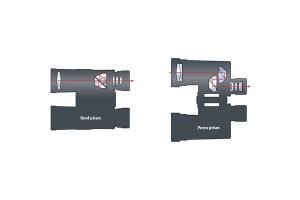
8×42 Roof Prism
The default choice. Expect 330–420 ft FOV depending on eyepiece design, bright images, and excellent balance. Slightly bulky for a golf shirt pocket but ideal in the cart or bag.
8×32 Roof Prism
A golf-friendly compact. Typical FOV runs 360–400 ft, making it extremely forgiving for ball tracking, while staying light enough to forget you are carrying it.
6.5×32 or 7×35
Wide, steady, and easy to hold on target. Excellent for seniors, first-time optic buyers, or anyone who struggles with shake. The trade-off is less detail at long range.
For golfers who want something durable enough for all-day outdoor use across different landscapes, models built with shockproof construction for rough handling often carry the same optical profiles that work well on a course.
Budget Reality Check
Expensive binoculars buy better edge sharpness, brighter coatings, and longer life. But mid-priced models now deliver 90 percent of the viewing performance. Cheap models, by contrast, often quote wide FOV numbers that look great on paper while delivering soft edges and poor contrast that make the field hard to actually use.
Practical Tips for Using Field of View Effectively During a Round
A good field of view still benefits from good technique. These habits make any golf binoculars perform better.
- Pre-aim before raising the binoculars. Keep your eyes on the ball, then bring the binoculars up to your eyes. Don't raise first and search second.
- Use both eyes for ball tracking. Squinting through one barrel halves your situational awareness and makes it harder to reacquire a moving ball.
- Adjust the diopter once, properly. Focus the right eyepiece on a distant flagstick at the start of the round. A mis-set diopter makes the whole field feel soft and unusable.
- Scan where the ball will land, not where it is. In practice, the best trackers lead the ball slightly and let the wide field swallow the landing zone.
- Carry them accessibly. A chest harness or quick-draw case means you actually use them tee to green, instead of leaving them in the cart. A dedicated waterproof case keeps a golf pair protected through dew, rain, and cart-cup spills.
Maintenance That Protects Your View Over Time
A dirty or fogged lens turns even a 400-foot field into a smeared mess. Protect your investment with a simple routine.
- Use a blower or brush first to remove dust and grit before wiping. Rubbing a dusty lens scratches coatings permanently.
- Wipe with a microfiber cloth in a circular motion from center outward. Add one drop of purpose-made lens cleaner to the cloth, never directly to the glass.
- Skip household products. Glass cleaner, paper towels, and shirt sleeves degrade multicoatings over time.
- Store in a dry, padded case with the dust caps on, and keep silica gel packets in the case if you play in humid climates.
- Check alignment annually. Even a minor drop can knock the barrels out of collimation, causing eye strain and headaches even when the view looks sharp.
Routine upkeep is small effort for years of crisp, wide viewing. For anyone whose gear goes from rugged trails to golf bags, understanding how to keep coatings intact in rough conditions is a useful companion skill.
Choosing the Right Pair for Your Game
Your ideal golf binoculars depend on how you play and how you watch.
For Players Who Track Their Own Ball
Prioritize wider FOV (340+ ft) and 6x–8x magnification in a compact body. You want to find the ball fast, confirm it is safe, and move on. A wide-view 8×32 or 6.5×32 is ideal.
For Spectators and Tournament Watchers
You are following multiple players, reading body language, and watching balls from many angles. A 7x–8x with 330–370 ft FOV and excellent brightness handles a full day on the course. Comfort and neck weight matter as much as optics.
For Golfers Who Also Hike, Camp, or Hunt
Look for a multi-sport design with rugged armor, waterproofing, and a neutral field of view that works from 50 yards on a green to 500 yards across a valley. A pair with versatile multi-sport capability saves you from buying two specialized sets.
If you are buying your first pair and feel overwhelmed by the spec sheets, start with a model aimed at entry-level golfers who need understandable choices, then refine from there.
Frequently Asked Questions
What field of view is ideal for golf binoculars?
Aim for 315 to 400 feet at 1,000 yards. This range gives enough width to track moving balls and see course context without sacrificing so much magnification that detail disappears.
Is a wider field of view always better for golf?
Not always. Beyond roughly 400 feet, manufacturers often achieve the width by lowering magnification or accepting softer edges. The sweet spot balances width, detail, and edge sharpness rather than maximizing width alone.
Can I use 10x binoculars for golf?
Yes, but the narrower field of view — usually under 320 feet — makes moving balls harder to follow without a monopod or very steady hands. Most golfers are happier at 6x to 8x.
What magnification gives the best field of view for golf?
6x and 7x models naturally provide the widest views, often 390 feet or more. An 8x pair typically lands around 330–360 feet, which is still excellent and adds useful detail at 200 yards.
Why do I keep losing the ball with my binoculars?
In practice, it is usually one of three things: a field of view under 300 feet, 10x magnification with handheld shake, or raising the binoculars after losing sight of the ball instead of tracking it continuously. A wider field and better pre-aiming fix most cases.
How does eye relief affect field of view?
Without enough eye relief, eyeglass wearers cannot see the full field of view. At least 15mm is recommended to access the complete image circle comfortably.
Conclusion
The best field of view for golf binoculars is not an extreme number — it is a balanced one. Look for roughly 330 to 400 feet at 1,000 yards, prioritize a magnification of 6x to 8x, and never ignore the supporting specs that determine whether that wide view is actually clear, bright, and comfortable for an entire round.
Choose binoculars that fit how you play and watch. A wider field makes every shot easier to follow, and a pair you actually carry beats a technically superior pair left in the car. Start with the field of view, confirm the magnification, check the eye relief, and you will end up with golf optics that genuinely improve your time on the course.