From "final| «" – okay_ready�` response" Here is the full rewrite:
What is the Best Field of View for Surveillance Binoculars? Expert Guide
Choosing a field of view (FOV) for surveillance is not about finding one magic number. It is about matching the width of your view to the job you are actually doing. In practice, the best field of view for surveillance binoculars usually falls between 300 and 400 feet at 1,000 yards, but that number only makes sense when you understand the trade-offs behind it.
A wider field of view lets you scan large areas quickly and track moving subjects without constantly moving the binoculars. A narrower field of view gives you more resolving power on distant details, but it creates blind spots around your target area. Get the balance wrong and you will either miss fast movement or struggle to identify what you are looking at.
This guide breaks down exactly how field of view works, which ranges suit different environments, and how to choose a pair that performs when it matters most.
Why Field of View Matters More in Surveillance Than in Birdwatching
Surveillance is a different optical task than recreational viewing. When you watch birds or scenery, you often have time to find and study a subject. When you are monitoring a perimeter, tracking a vehicle, or watching a subject move between buildings, you need to acquire the target quickly and stay on it.
The field of view determines how much of the scene you can see without panning the binoculars. For surveillance, that directly affects three things:
- Detection speed: A wider FOV helps you notice movement at the edge of your vision.
- Tracking stability: You can follow a moving subject longer before it leaves the frame.
- Eye fatigue: A too-narrow view forces constant repositioning, which wears you out during long observation sessions.
A common mistake is choosing surveillance binoculars the same way you would choose hunting or astronomy optics — prioritizing magnification above all else. In surveillance, situational awareness often matters more than raw detail. That is why many experienced observers gravitate toward 7x or 8x models rather than high-magnification glass.
If you are comparing systems, it helps to think about how magnification affects surveillance work before you lock in a field of view.
Understanding Field of View Measurements: Degrees vs. Feet
Field of view is expressed in two main ways, and understanding both prevents expensive mistakes.
Angular Field of View
This is measured in degrees. It describes the angle of the scene visible through the eyepiece. A wider angle means more of the world fits into the image circle. Most surveillance-friendly binoculars sit between 5.5° and 8.5°.
Linear Field of View
This is usually expressed as feet at 1,000 yards, though you may also see meters at 1,000 meters. A specification of 350 feet at 1,000 yards means you see a horizontal span of 350 feet when looking at something 1,000 yards away.
A useful rule of thumb: 1 degree of angular FOV equals about 52.5 feet at 1,000 yards. So an 8° binocular is roughly 420 feet at 1,000 yards, while a 6° model is closer to 315 feet.
When comparing models, always use the same unit. Some manufacturers advertise angular FOV because the degree number sounds smaller and cleaner, even when the actual visible area is unremarkable. Converting between the two takes seconds and gives you an honest comparison.
The Real Trade-Off: Magnification vs. Field of View
Field of view and magnification pull in opposite directions. Higher magnification enlarges the subject, but it narrows the angle you can observe. Lower magnification shrinks distant details, but it widens the scene.
Here is how that typically plays out in real binoculars:
| Magnification | Typical Angular FOV | Typical Linear FOV (ft @ 1,000 yds) | Surveillance Use |
|---|---|---|---|
| 7x | 6.5° – 8.5° | 340 – 445 | General monitoring, tracking |
| 8x | 6° – 8° | 315 – 420 | Balanced all-purpose work |
| 10x | 5° – 6.5° | 260 – 340 | Long-range identification |
| 12x | 4.5° – 5.5° | 235 – 290 | Stationary detail work |
In practice, 10x and 12x binoculars are frustrating for surveillance unless you are using a tripod and watching a fixed point. The image shake from hand movement compounds the narrow view, making it difficult to find and follow anything that moves.
A 7x or 8x pair gives you a wider field and more stable image. For most surveillance tasks, that is the better starting point. You can read more about choosing the right magnification for surveillance binoculars if you are still torn between powers.
Optimal Field of View for Different Surveillance Environments
The right FOV shifts depending on where you are working and what you are watching. These ranges are practical starting points, not rigid rules.
Urban Surveillance
Urban environments are visually dense. You are dealing with multiple buildings, intersecting streets, reflective surfaces, and frequent movement across short and medium distances. A wider field of view helps you keep track of multiple potential subjects and entry points.
Recommended range: 6° to 8° angular, or roughly 315 to 420 feet at 1,000 yards.
This works well for watching building entrances, monitoring foot traffic, or following a target through a crowd. A narrower view will force you to constantly swing the binoculars, and you will lose context.
Rural and Open-Area Surveillance
In open terrain, subjects are often farther away, and the background is less cluttered. You may be watching a treeline, a rural road, or a field where nothing happens for long periods. Here, you often want more magnification, but you still need enough FOV to spot movement before it disappears.
Recommended range: 5° to 7° angular, or roughly 260 to 370 feet at 1,000 yards.
This balances longer reach with enough peripheral awareness to catch activity outside your immediate focus.
Maritime and Coastal Surveillance
Water and coastlines involve long, open sightlines and moving subjects like boats, swimmers, or shoreline traffic. Waves and vessel motion also make a steady view harder. A wider field is valuable here because you are often scanning a horizon rather than studying a fixed point.
Recommended range: 7° to 9° angular, or roughly 370 to 470 feet at 1,000 yards.
Image-stabilized binoculars are particularly useful in marine settings, where platform movement reduces the benefit of high magnification.
Low-Light and Night Surveillance
In low light, a wider field of view does not automatically mean a brighter image. What matters most is exit pupil — the diameter of the light beam leaving the eyepiece. Larger objective lenses and moderate magnification combine to deliver more light.
The National Institute of Standards and Technology (NIST) publishes detailed technical standards for optical performance that help explain how optical systems behave under different conditions, though most buyers will not need that level of specification. The practical takeaway is simpler: a wide exit pupil matters for low-light viewing because it keeps the image usable when ambient light drops.
How Lens Design, Prism Type, and Coatings Affect FOV
Field of view is not purely a magnification number. The optical architecture inside the binoculars changes how wide the image appears.
Prism Type
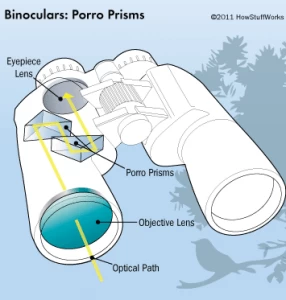
Porro prism binoculars typically offer wider fields of view at a given magnification than compact roof prism designs. The physical layout allows for wider eyepieces. However, porro models are often bulkier, which matters if you are carrying them for hours.
Roof prism binoculars are more compact but must work harder optically to produce a wide field. Higher-end roof prism models can match or exceed porro FOV, but they cost more to do it.
Eyepiece Design
The eyepiece determines how much of the objective lens's image circle you actually see. Wide-angle eyepieces use more complex lens arrangements to expand the apparent field without sacrificing edge sharpness. Cheap wide-angle binoculars often suffer from soft or distorted edges, which reduces the usable FOV even if the published number looks impressive.
Lens Coatings
Multi-coated and fully multi-coated lenses transmit more light and improve contrast, especially at the edges of the field. Better coatings do not technically widen the FOV, but they make the entire field more usable. Durable lens coatings also protect against scratches that degrade edge clarity over time.
Apparent vs. True Field of View
Apparent field of view is the angular width of the image as seen through the eyepiece. True field of view is the actual angle of the scene captured. A wide apparent field gives a more immersive viewing experience, but the true field still determines how much real-world area you are covering. Some marketing emphasizes apparent FOV because it sounds larger.
Wide vs. Narrow Field of View: When Each Actually Wins
The wide-versus-narrow debate is not a contest. Each has specific situations where it is the correct tool.
When a Wide FOV Wins
A wide view is better when you need to see the whole picture quickly. It supports faster target acquisition, smoother tracking of moving subjects, and less eye fatigue during long sessions. Wide FOV is the right choice for scanning parking lots, watching a crowd, or keeping a building entrance under observation while also noting what happens at the street level.
When a Narrow FOV Wins
A narrow view is better when you already know where to look and need to extract detail from that spot. It gives more magnification and better identification potential. Narrow FOV is the right choice for reading a license plate, identifying a face at distance, or watching a fixed doorway when you do not need to monitor the surrounding area.
The Balanced Approach
Most professionals do not rely on one pair. A moderate 8x binocular with a FOV around 350 feet at 1,000 yards is the best general-purpose compromise. If your work requires both wide scanning and detailed identification, consider a two-system approach rather than trying to make one pair do everything.
How to Read a Binocular Specification Sheet Without Being Misled
Manufacturers list FOV in different formats, and some spec sheets are more honest than others. Before buying, check for these details:
- Is FOV listed in degrees or feet? If a spec says "8.1°" without linear measurement, convert it. That may still be narrower than a model advertising "372 ft @ 1,000 yds."
- Is the linear FOV at 1,000 yards or 1,000 meters? The difference is about 9%. A spec in yards looks larger than the identical view expressed in meters.
- Is the eyepiece truly wide-angle? Look for the apparent field of view. Something around 60° or above feels comfortable; below 50° feels tunnel-like regardless of the true FOV.
- Is the image sharp to the edge? A wide FOV with blurry edges is less useful than a slightly narrower FOV that stays sharp across the frame.
A practical way to evaluate this without testing is to check whether the manufacturer publishes both true and apparent FOV, and whether reviews mention edge softness. If neither is available, be cautious about claims of extreme width.
Expert Recommendations by Use Case
Here are practical starting points based on common surveillance tasks.
| Use Case | Suggested Magnification | Suggested FOV (ft @ 1,000 yds) | Key Feature to Prioritize |
|---|---|---|---|
| Urban street monitoring | 7x – 8x | 360 – 420 | Wide FOV, compact size |
| Parking lot and perimeter | 8x | 330 – 390 | Balanced view, durable body |
| Rural road and treeline | 8x – 10x | 300 – 360 | Higher magnification, steady grip |
| Marine and coastline | 7x | 390 – 460 | Wide FOV, waterproofing |
| Fixed-point identification | 10x – 12x | 250 – 320 | Tripod mount, sharp center field |
| Night and low light | 7x – 8x | 330 – 400 | Large exit pupil, quality coatings |
Notice that none of these recommendations chase maximum magnification. For surveillance, stability and usable field are almost always more valuable than raw power.
If you need something durable for field work, shockproof hiking binoculars often translate well to surveillance because they are built to survive rough movement and changing conditions.

Surveillance binoculars with a moderate field of view are easier to hold steady for long observation periods.
Tripods, Stabilization, and the FOV You Can Actually Use
A wide field of view matters less if you cannot hold the binoculars steady. At higher magnifications, hand movement becomes magnified along with the image. This shakes the view and cancels out much of the benefit of a wider field.
In practice, most people can hold 7x or 8x binoculars reasonably steady for short periods. At 10x and above, a tripod or image stabilization is nearly essential for surveillance that lasts more than a few minutes.
Adding a tripod also changes the FOV equation. A stable platform lets you use a narrower field without losing track of your subject, because you can pan smoothly instead of fighting hand shake. A tripod-mounted setup is a practical upgrade if your surveillance position is fixed.
Maintenance and Care for Consistent Optical Performance
Dirty or misaligned optics reduce usable field of view more than most people realize. Dust and smudges scatter light, lower contrast, and make the edges of the image appear worse than they are.
To keep your binoculars performing at their specced FOV:
- Use a soft brush or air blower to remove loose dust before wiping.
- Wipe lenses only with a clean microfiber cloth.
- Use a lens cleaning solution sparingly, and never apply harsh household chemicals.
- Store binoculars in a dry, padded case away from direct sunlight and extreme temperatures.
- Keep lens caps closed when not in use.
- Check the diopter and interpupillary distance settings periodically; a poor fit can create the illusion of a narrower field.

Regular lens care preserves edge clarity and keeps the full field of view usable.
If you want a full checklist of useful gear to pair with your optics, surveillance binocular accessories covers the practical add-ons that make field work easier.

A stable viewing position improves the effective field of view during long surveillance sessions.
Frequently Asked Questions
What is the best field of view for surveillance binoculars?
For most surveillance work, a field of view between 300 and 400 feet at 1,000 yards is the most practical. This range balances wide-area scanning with enough detail to identify subjects at medium distances. The specific number within that range depends on your environment and whether you prioritize tracking or identification.
Does a wider field of view make surveillance easier?
In dynamic situations, yes. A wider field of view helps you detect movement sooner and track subjects longer without panning. In static situations where you are watching one fixed point, a narrower field with higher magnification is often more useful.
Can I use high-magnification binoculars for surveillance?
You can, but high magnification narrows the field of view and amplifies hand shake. Above 10x, a tripod or image stabilization becomes important. Most surveillance tasks are better served by 7x or 8x binoculars with a moderate field of view.
Is field of view more important than magnification for surveillance?
For most surveillance scenarios, field of view is at least as important as magnification, and often more so. Magnification helps you identify details once you have found a target; field of view helps you find and track the target in the first place.
What is the difference between angular and linear field of view?
Angular field of view is measured in degrees, while linear field of view is measured in feet or meters at a specific distance, usually 1,000 yards or meters. One degree equals approximately 52.5 feet at 1,000 yards.
Do roof prism or porro prism binoculars have a wider field of view?
Porro prism binoculars generally offer wider fields of view at lower prices, but they are bulkier. Roof prism models can match or exceed that width with better engineering, but they often cost more to do it.
Conclusion: Match the Field to the Mission
The best field of view for surveillance binoculars is not a universal spec. It is the widest field you can get without sacrificing the detail you need for the specific environment you are watching.
For open urban or maritime scanning, prioritize a wide field in the 7° to 8.5° range. For rural or fixed-point detail work, accept a narrower field in exchange for more reach. For most mixed-use surveillance, a 7x or 8x binocular with around 350 feet at 1,000 yards is the sensible center point.
Start by defining where and how you will use the binoculars. Then compare true field of view in the same units across models. Choose stability and usable edge sharpness over an inflated spec. The right pair is the one that keeps the whole scene in view without forcing you to work for it.
For a broader look at optics suited to extended outdoor use, compare nature observation binoculars that balance field width with durability.