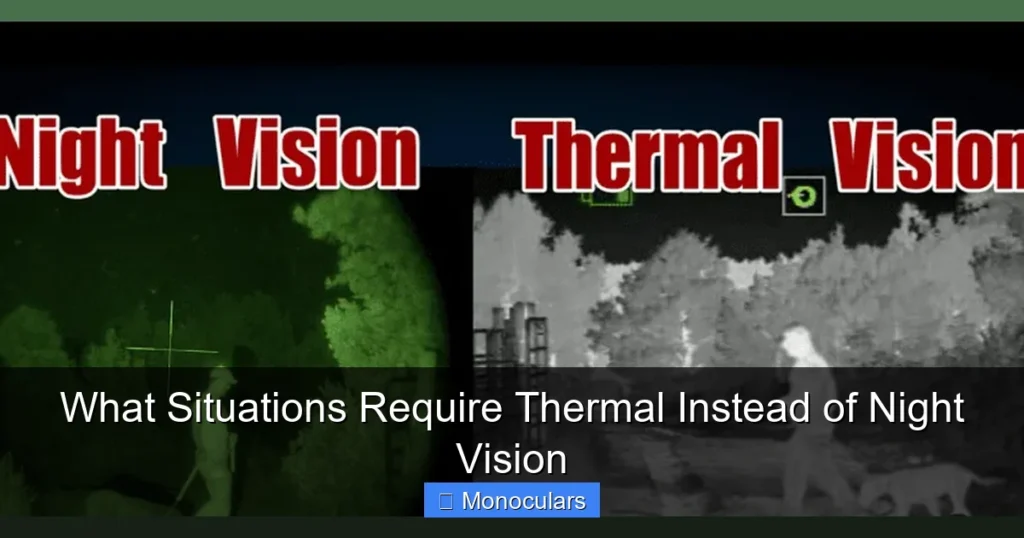
Thermal imaging and night vision both enhance visibility in the dark, but they work in fundamentally different ways. While night vision amplifies available light, thermal detects heat signatures—making it the superior choice in specific real-world situations like total darkness, fog, or dense foliage.
When the sun goes down, visibility drops—fast. Whether you’re a hunter tracking game, a security professional on patrol, or an outdoor enthusiast exploring after dark, having the right optical tool can mean the difference between success and failure. Two of the most popular technologies for low-light viewing are night vision and thermal imaging. Both are commonly found in monoculars—compact, handheld devices that offer powerful magnification and clarity. But here’s the catch: they don’t perform equally in every situation.
Night vision has been around for decades and works by amplifying available light—like moonlight, starlight, or infrared illumination—to create a visible image. It’s great when there’s *some* light to work with. But what happens when it’s pitch black, foggy, or the target is hidden behind foliage? That’s where thermal imaging steps in. Instead of relying on light, thermal detects heat emitted by objects, people, or animals. This fundamental difference makes thermal the go-to choice in specific, challenging environments where night vision simply can’t keep up.
Understanding when to use thermal instead of night vision isn’t just about preference—it’s about effectiveness, safety, and mission success. In this guide, we’ll break down the exact situations where thermal monoculars outperform their night vision counterparts, helping you make the smart choice for your needs.
Key Takeaways
- Total darkness or zero-light environments: Thermal works without any ambient light, unlike night vision which needs minimal illumination.
- Adverse weather conditions: Thermal imaging penetrates fog, smoke, and light rain better than night vision, which struggles in such conditions.
- Concealed or camouflaged targets: Thermal detects body heat through light cover like leaves or brush, while night vision relies on visible outlines.
- Long-range detection: Thermal excels at spotting distant heat sources, especially useful in open terrain or security operations.
- Search and rescue missions: Thermal helps locate missing persons by detecting body heat, even under debris or in dense forests.
- Wildlife observation and hunting: Thermal allows ethical tracking of animals without disturbing them with light or sound.
- Security and surveillance: Thermal provides reliable intruder detection regardless of lighting or camouflage attempts.
📑 Table of Contents
- 1. Operating in Total Darkness or Zero-Light Conditions
- 2. Navigating Through Fog, Smoke, or Light Precipitation
- 3. Detecting Concealed or Camouflaged Targets
- 4. Long-Range Observation in Open or Complex Terrain
- 5. Search and Rescue in Challenging Environments
- 6. Wildlife Observation Without Disturbance
- Conclusion: Choosing the Right Tool for the Job
1. Operating in Total Darkness or Zero-Light Conditions
One of the most obvious advantages of thermal imaging is its ability to function in complete darkness. Night vision devices (NVDs) require at least a small amount of ambient light—such as moonlight or starlight—to produce an image. If you’re deep in a forest with thick canopy cover, inside a building with no windows, or in a cave, night vision may produce a dim or unusable image.
Thermal, on the other hand, doesn’t care about light. It detects infrared radiation (heat) emitted by all living things and warm objects. A human body, for example, radiates heat at around 98.6°F (37°C), which stands out clearly against cooler backgrounds—even in total blackness. This makes thermal monoculars ideal for nighttime security checks, cave exploration, or tactical operations where stealth and visibility are critical.
Practical Example:
Imagine you’re a park ranger conducting a nighttime patrol in a remote forest. The moon is hidden behind thick clouds, and the forest floor is pitch black. With a night vision monocular, you might see vague shapes or nothing at all. But with a thermal monocular, you can instantly spot a poacher’s campfire, a hidden vehicle engine, or even a person crouched behind a tree—all based on heat signatures.
2. Navigating Through Fog, Smoke, or Light Precipitation
Weather can quickly degrade the performance of night vision. Fog, smoke, light rain, or snow scatter and absorb the little available light, making it harder for night vision devices to form a clear image. This is especially problematic for security personnel, firefighters, or outdoor adventurers who operate in unpredictable conditions.
Thermal imaging, however, is far more resilient. Infrared wavelengths used by thermal sensors can penetrate obscurants like fog and smoke more effectively than visible light. While heavy rain or snow can slightly reduce thermal range, it still maintains functionality where night vision might fail completely.
Real-World Application:
Firefighters use thermal cameras to navigate smoke-filled buildings because they can see through the haze to locate people or hotspots. Similarly, a hunter tracking deer in a foggy valley will have a much clearer view with thermal than with night vision. Even light drizzle can wash out a night vision image, but thermal remains reliable.
3. Detecting Concealed or Camouflaged Targets
Camouflage is designed to blend into the background—breaking up outlines and mimicking natural textures. While this can fool the human eye and night vision devices, it’s nearly useless against thermal imaging. A person hiding in bushes, wearing ghillie suits, or lying in tall grass still emits body heat, which thermal sensors detect easily.
Night vision, by contrast, relies on visible shapes and contrasts. If a target is well-hidden or motionless, it may go unnoticed—even if it’s just a few feet away. Thermal cuts through this deception by highlighting heat differences, making it invaluable for military operations, law enforcement, and even wildlife observation.
Tip for Hunters:
If you’re hunting feral hogs or coyotes that are known to freeze and hide in thick cover, a thermal monocular can reveal their location long before they’re visible to the naked eye or night vision. This not only improves your success rate but also promotes ethical hunting by ensuring clean, visible shots.
4. Long-Range Observation in Open or Complex Terrain
Thermal imaging excels at long-range detection, especially in open areas like deserts, fields, or coastlines. Because it detects heat rather than relying on reflected light, thermal can spot a person or vehicle from several hundred meters away—even if they’re not moving.
Night vision, while useful at medium ranges, struggles with distance in low-light conditions. The image can become grainy, and small details fade. Thermal maintains clarity over longer distances, making it ideal for border patrol, perimeter security, or wildlife monitoring.
Example Use Case:
A security team monitoring a remote facility can use thermal monoculars to scan the surrounding area for intruders. Even if someone is crawling through tall grass 300 yards away, their body heat will appear as a bright spot on the thermal display. Night vision might miss them entirely unless they’re closer or moving.
5. Search and Rescue in Challenging Environments
When someone goes missing in the wilderness, time is critical. Search and rescue (SAR) teams often operate at night or in dense forests where visibility is poor. Thermal imaging dramatically increases the chances of finding a person quickly.
Unlike night vision, which requires light and clear sightlines, thermal can detect a person’s body heat through light debris, underbrush, or even inside a vehicle. This is especially useful in cases where the missing person is unconscious, injured, or unable to call for help.
Pro Tip:
Pair a thermal monocular with GPS and communication tools for maximum efficiency. Many modern thermal devices also feature digital zoom and image recording, allowing rescuers to document findings and coordinate efforts in real time.
6. Wildlife Observation Without Disturbance
Night vision often requires an infrared (IR) illuminator to boost visibility in total darkness. While invisible to the human eye, this IR light can still be detected by animals with sensitive vision, potentially startling them or altering their natural behavior.
Thermal imaging, however, is completely passive—it doesn’t emit any light or radiation. This makes it perfect for observing nocturnal animals like owls, raccoons, or deer without disturbing them. Researchers, photographers, and nature enthusiasts can study animal behavior in their natural habitat with minimal interference.
Bonus Insight:
Thermal can also help identify animal trails, dens, or feeding areas by detecting residual heat from recent activity. This is useful for tracking patterns over time without needing to be physically present during the day.
Conclusion: Choosing the Right Tool for the Job
Both thermal and night vision monoculars have their place in the world of low-light optics. Night vision is excellent for situations with some ambient light, offering detailed, real-time imagery at a lower cost. But when the environment becomes challenging—whether due to darkness, weather, concealment, or distance—thermal imaging proves its worth.
The key is understanding your specific needs. If you’re a hunter tracking game in dense woods, a security officer on night patrol, or a rescuer searching for missing persons, thermal imaging provides unmatched reliability and detection power. It sees what the eye cannot, cuts through obstacles, and delivers results when it matters most.
Investing in a quality thermal monocular isn’t just about seeing in the dark—it’s about seeing *through* the challenges that darkness brings. With advancements in technology, thermal devices are becoming more affordable, compact, and user-friendly, making them accessible to a wider range of users.
So, the next time you’re deciding between thermal and night vision, ask yourself: What am I trying to see? And under what conditions? The answer will guide you to the right tool—and the right outcome.
Frequently Asked Questions
Can thermal imaging see through walls?
No, thermal imaging cannot see through solid walls. It detects surface heat, so it can show heat signatures on the outside of a wall (like a warm spot from a person standing nearby), but it cannot penetrate the wall to see inside.
Does thermal work in daylight?
Yes, thermal imaging works equally well in daylight and darkness. Since it detects heat rather than light, it’s not affected by the sun. In fact, thermal can be especially useful during the day when heat contrasts are strong.
Is thermal imaging legal for hunting?
Laws vary by region. In many places, using thermal for hunting is legal, but some areas restrict its use during certain seasons or for specific game. Always check local regulations before using thermal devices for hunting.
How far can a thermal monocular see?
Range depends on the device’s resolution and lens quality. Entry-level models may detect humans up to 500 yards, while high-end monoculars can identify targets over a mile away under ideal conditions.
Do thermal monoculars need batteries?
Yes, thermal monoculars require power to operate the sensor and display. Most use rechargeable or replaceable batteries and offer several hours of runtime, depending on usage and settings.
Can thermal imaging detect animals in trees?
Yes, thermal can detect animals in trees by sensing their body heat. Even if an animal is hidden among leaves, its warmth will stand out against the cooler background, making it visible to a thermal monocular.