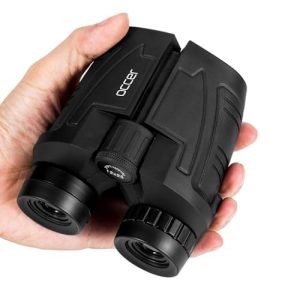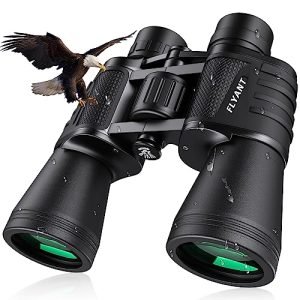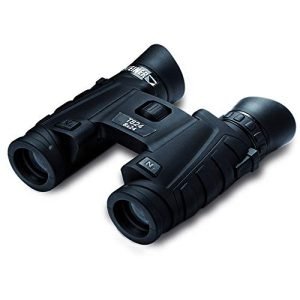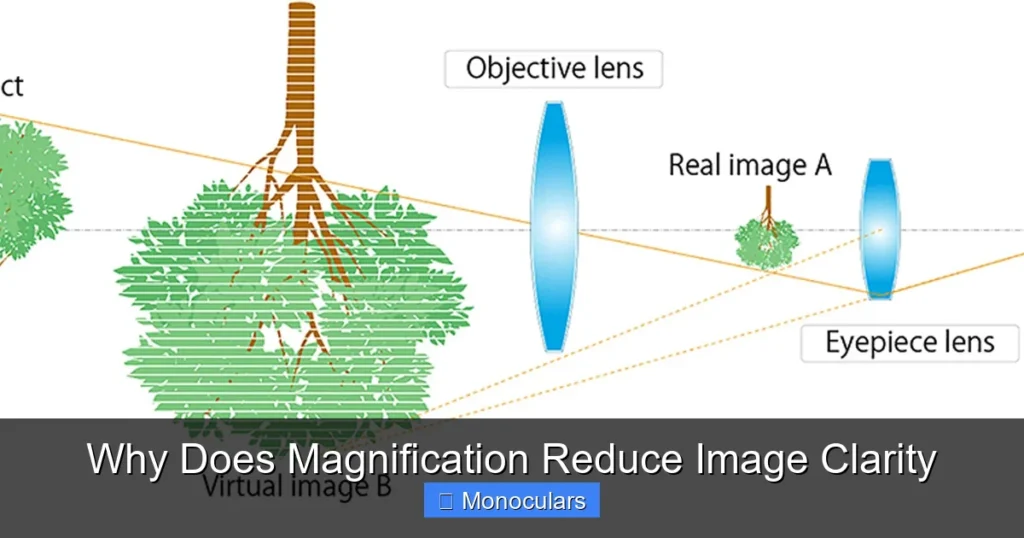
Magnification reduces image clarity because it amplifies not just the subject but also optical flaws, light limitations, and hand movements. While higher zoom seems better, it often results in dimmer, blurrier, and shakier images—especially in compact optics like monoculars.
Have you ever looked through a monocular and cranked up the zoom, only to find the image getting blurrier instead of sharper? It’s frustrating—especially when you’re trying to spot a bird on a distant tree or read a sign across a canyon. You’d think more magnification would mean better detail, but often, the opposite happens. Why does magnification reduce image clarity?
The answer lies in the physics of optics and the practical limits of compact devices like monoculars. While magnification makes objects appear larger, it also magnifies every imperfection—both in the device and in the environment. From lens quality to hand stability, many factors come into play. Understanding these helps you choose the right monocular and use it effectively, so you get the clearest, most useful view possible.
In this article, we’ll break down the science behind why higher magnification often leads to lower image quality. We’ll explore how light, lens design, and human factors all contribute to this common issue. Whether you’re a hiker, birdwatcher, or outdoor enthusiast, knowing how to balance zoom and clarity will help you get the most out of your gear.
Key Takeaways
- Magnification amplifies optical imperfections: Lens flaws, dust, and manufacturing defects become more visible at higher zoom levels.
- Light gathering decreases with zoom: Higher magnification spreads available light over a larger image area, making the image dimmer and less clear.
- Hand shake is magnified: Even slight movements become exaggerated at high power, causing blurry or shaky views.
- Diffraction limits resolution: At extreme zoom, light waves bend around small lens apertures, reducing fine detail.
- Atmospheric interference increases: Heat waves, haze, and air turbulence distort distant images more at higher magnifications.
- Exit pupil size shrinks: Smaller exit pupils (common in high-mag monoculars) reduce brightness and sharpness, especially in low light.
- Balance is key: The best monocular performance comes from matching magnification to lens quality, lighting, and use case—not just max zoom.
📑 Table of Contents
How Magnification Affects Light and Brightness
One of the most overlooked reasons magnification reduces image clarity is its impact on brightness. When you increase magnification, you’re essentially spreading the same amount of light over a larger image area. Think of it like shining a flashlight on a wall: if you move the flashlight farther back, the beam spreads out and gets dimmer. The same principle applies inside your monocular.
The Role of Exit Pupil
The exit pupil is the tiny circle of light that exits the eyepiece and enters your eye. It’s calculated by dividing the objective lens diameter (in millimeters) by the magnification. For example, a 10×42 monocular has an exit pupil of 4.2mm (42 ÷ 10). A larger exit pupil delivers more light to your eye, resulting in a brighter, clearer image—especially in low-light conditions like dawn or dusk.
But as magnification increases, the exit pupil shrinks. A 20×42 monocular, for instance, has an exit pupil of just 2.1mm. That’s half the light reaching your eye. In dim lighting, your pupil may only open to 3mm or 4mm, so a 2.1mm exit pupil can’t fully fill it. The result? A darker, less detailed image.
Low Light Performance Suffers
This effect is especially noticeable in low-light environments. If you’re using a high-magnification monocular at sunset or in a forest canopy, the image will appear dim and washed out. Even if the optics are high quality, there simply isn’t enough light to maintain clarity at high zoom. That’s why many birdwatchers and hunters prefer lower magnification (like 8x or 10x) with larger objective lenses—they prioritize brightness over extreme zoom.
Practical tip: If you plan to use your monocular in the early morning or evening, choose a model with a larger objective lens (42mm or more) and moderate magnification. This balance ensures enough light gets through for a clear, bright view.
Optical Imperfections Are Magnified Too
Magnification doesn’t just enlarge the subject—it also amplifies any flaws in the lens system. Even the best monoculars have minor imperfections due to manufacturing tolerances, lens coatings, or alignment issues. At low magnification, these flaws are barely noticeable. But crank up the zoom, and they become glaringly obvious.
Chromatic and Spherical Aberration
Two common optical issues are chromatic aberration (color fringing) and spherical aberration (blurred focus). Chromatic aberration happens when different colors of light focus at slightly different points, creating rainbow-like edges around objects. Spherical aberration occurs when light rays hitting the edge of a lens don’t focus at the same point as those near the center.
At higher magnification, these problems become more pronounced. A tiny purple fringe around a bird’s wing might be invisible at 8x, but at 15x, it can dominate the image. Similarly, soft focus at the edges of the frame becomes more distracting when everything is enlarged.
Lens Quality Matters More at High Zoom
This is why lens quality becomes critical as magnification increases. Premium monoculars use multi-coated lenses, extra-low dispersion (ED) glass, and precision alignment to minimize these flaws. Budget models often cut corners, making high magnification nearly unusable due to blur and color distortion.
Example: Compare a $50 monocular with 12x magnification to a $200 model with the same zoom. The cheaper one will likely show significant color fringing and softness, while the higher-end version maintains sharpness and color accuracy. The difference? Better glass and coatings that handle high magnification more effectively.
Hand Shake and Stability Issues
Even the steadiest hands can’t eliminate micro-movements. When you hold a monocular, your natural hand tremors—often too small to notice with the naked eye—get magnified along with the image. This is why high-magnification viewing often results in a shaky, unstable picture.
The Rule of Thumb for Handheld Use
A common guideline is that handheld monoculars should not exceed 10x to 12x magnification. Beyond that, image stability drops dramatically. At 15x or 20x, even breathing or heartbeat can cause noticeable movement. The result? A blurry, jumpy view that makes it hard to focus on details.
This is one reason why spotting scopes—used with tripods—often go up to 60x magnification. The tripod eliminates hand shake, allowing the optics to perform at their best. But monoculars are designed for portability and handheld use, so they’re limited by human physiology.
Image Stabilization Helps—But Isn’t Perfect
Some advanced monoculars now include electronic image stabilization (IS), which uses gyroscopes and motors to counteract movement. While this technology improves stability, it’s not a magic fix. It can’t compensate for extreme shake or poor lighting, and it adds cost, weight, and battery dependency.
Practical tip: If you need high magnification, consider using a small tripod or resting your arm on a stable surface. Even leaning against a tree can reduce shake and improve clarity.
Diffraction and the Limits of Resolution
There’s a fundamental physical limit to how much detail any optical system can resolve—and magnification can push you right up against it. This limit is governed by diffraction, a phenomenon where light waves bend around small openings, like the aperture of a lens.
How Diffraction Affects Image Sharpness
As magnification increases, the effective aperture (relative to the image size) gets smaller. This causes light waves to spread out more, reducing the system’s ability to resolve fine details. Think of it like trying to read tiny print through a pinhole—the smaller the hole, the blurrier the text becomes, no matter how much you zoom in.
This effect becomes noticeable when magnification exceeds what the lens aperture can support. For example, a monocular with a 30mm objective lens starts to lose resolution around 15x to 20x due to diffraction. Pushing it to 25x won’t reveal more detail—it will just make the existing blur larger.
The Sweet Spot for Clarity
Every monocular has a “sweet spot” where magnification and aperture work together for maximum clarity. For most compact monoculars, this is between 8x and 12x. Beyond that, gains in apparent size are offset by losses in sharpness and brightness.
Example: A 10×42 monocular typically delivers excellent clarity, while a 15×42 of the same quality may look softer and dimmer. The extra zoom doesn’t add useful detail—it just magnifies the limitations.
Atmospheric Conditions Play a Big Role
Even with perfect optics and steady hands, the atmosphere itself can degrade image quality—especially at high magnification. Heat waves, humidity, dust, and air turbulence all distort light as it travels from the subject to your monocular.
Heat Haze and Air Turbulence
On a hot day, air near the ground heats up and rises, creating shimmering waves of distorted light. This is especially common when viewing distant objects across open fields or water. At low magnification, this haze is subtle. But at high zoom, it becomes a major obstacle, making distant objects appear wavy or blurry.
Similarly, wind and temperature gradients in the atmosphere can bend light paths, reducing contrast and sharpness. This is why astronomers often wait for “steady air” conditions to observe stars—because even tiny atmospheric disturbances are magnified at high power.
Distance Magnifies Atmospheric Effects
The farther away your subject, the more atmosphere the light must pass through. A bird 100 yards away might look clear at 10x, but at 20x, the cumulative effect of haze and turbulence can make it unrecognizable. This is why long-range viewing often benefits more from better lighting and stable air than from higher magnification.
Practical tip: For distant viewing, try to observe during cooler, calmer parts of the day—like early morning—when the air is more stable. Avoid high magnification on hot, windy afternoons.
Finding the Right Balance for Your Needs
So, does that mean high magnification is always bad? Not necessarily. The key is understanding the trade-offs and choosing the right tool for your situation.
Match Magnification to Your Use Case
– For hiking or general outdoor use: 8x to 10x magnification with a 42mm lens offers the best balance of clarity, brightness, and portability.
– For birdwatching: 8×42 or 10×42 models provide sharp, bright images with enough detail to identify species.
– For long-range scouting: Consider a 12×50 monocular, but use a tripod or rest for stability.
– For astronomy or extreme distance: A spotting scope with a tripod is better than a high-mag monocular.
Don’t Chase the Highest Number
Marketing often emphasizes high magnification as a selling point, but it’s not the only—or even the most important—factor. A 20x monocular with poor optics will perform worse than an 8x with high-quality glass. Focus on overall image quality, lens coatings, and build durability instead of just the zoom number.
Test Before You Buy
If possible, try out different monoculars in real-world conditions. Look through them at various magnifications and lighting levels. Pay attention to brightness, color accuracy, edge sharpness, and stability. Your eyes will tell you more than any spec sheet.
Conclusion
Magnification reduces image clarity not because it’s inherently flawed, but because it magnifies every limitation in the optical system and environment. From reduced brightness and amplified hand shake to diffraction and atmospheric distortion, higher zoom often comes at the cost of sharpness and usability.
The best monocular experience comes from balance—not maximum magnification. By understanding how light, optics, and physics interact, you can choose a device that delivers clear, bright, and stable images for your specific needs. Whether you’re scanning a mountain range or watching wildlife, the right tool used wisely will always outperform a high-zoom gadget pushed beyond its limits.
Frequently Asked Questions
Why does my monocular get blurry when I zoom in?
Higher magnification amplifies lens flaws, reduces brightness, and magnifies hand shake, all of which contribute to a blurrier image. The optics may also be hitting their diffraction limit, where more zoom doesn’t add detail.
Is 12x magnification too much for a monocular?
It depends on the lens quality and lighting. 12x can work well with a large objective lens (50mm+) and stable handling, but it may be too much for handheld use in low light or with budget optics.
Can image stabilization fix blurry high-magnification views?
Image stabilization helps reduce shake, but it can’t fix poor optics, low light, or atmospheric distortion. It’s a useful feature, but not a complete solution for clarity issues.
Why do distant objects look worse at high zoom?
At high magnification, atmospheric effects like heat haze, air turbulence, and dust become more visible. These distortions are always present but are only noticeable when the image is greatly enlarged.
What’s the best magnification for a handheld monocular?
8x to 10x is ideal for most handheld use. It offers good detail without excessive shake or brightness loss, especially when paired with a 42mm or larger objective lens.
Does a bigger lens always mean better image clarity?
Not always. While a larger lens gathers more light, clarity also depends on lens quality, coatings, and alignment. A well-made 8×42 can outperform a poorly made 12×50 in real-world conditions.