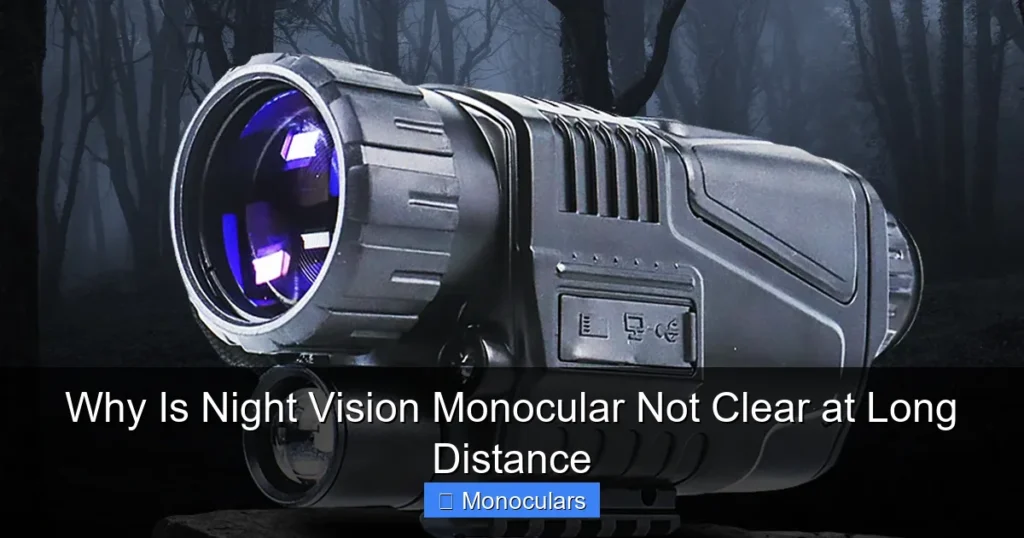
Night vision monoculars often struggle with clarity at long distances due to limitations in image intensifier tubes, low light conditions, and atmospheric interference. Understanding these factors helps you choose the right device and optimize its use for better nighttime visibility.
Have you ever pointed your night vision monocular into the dark, hoping to spot a deer or intruder far away, only to see a blurry, grainy mess? You’re not alone. Many users expect crystal-clear vision through their monoculars at long distances, but reality often falls short. The truth is, night vision technology—especially in monocular form—has inherent limitations that affect clarity when viewing objects far away. Understanding why your night vision monocular is not clear at long distance can help you set realistic expectations and make smarter purchasing and usage decisions.
Night vision doesn’t work like a flashlight that illuminates everything in its path. Instead, it amplifies existing light—such as moonlight, starlight, or artificial infrared (IR) light—to create a visible image. This process, while impressive, has boundaries. Factors like the quality of the internal components, environmental conditions, and even the time of night all influence how well you can see at a distance. If you’re using a budget monocular or relying on minimal ambient light, don’t be surprised when distant objects appear fuzzy or indistinct. The good news? With the right knowledge, you can significantly improve your experience.
Key Takeaways
- Image intensifier tube generation matters: Higher-gen tubes (Gen 2+, Gen 3) offer better resolution and longer effective range than Gen 1 models.
- Low ambient light reduces clarity: Monoculars rely on available light; without moonlight or starlight, images become grainy and unclear.
- Atmospheric conditions play a role: Fog, rain, dust, and humidity scatter light, reducing image sharpness over distance.
- Optical quality and magnification limit range: Poor lens coatings or excessive digital zoom can degrade image quality beyond 100–200 yards.
- Digital vs. analog technology differs: Digital night vision may offer zoom but often sacrifices resolution at range compared to high-end analog systems.
- Proper focus and settings are essential: Failing to adjust focus or use IR illuminators can result in blurry long-distance views.
- Environmental awareness improves results: Scouting terrain during the day and using reference points helps interpret night images more accurately.
📑 Table of Contents
How Night Vision Monoculars Work
To understand why clarity drops at long range, it helps to know how these devices function. Most traditional night vision monoculars use an image intensifier tube—the heart of the system. This tube captures photons (light particles) entering through the lens and converts them into electrons. These electrons are then amplified thousands of times and shot onto a phosphor screen, creating the green-hued image you see through the eyepiece.
Analog vs. Digital Night Vision
There are two main types of night vision technology: analog (traditional) and digital. Analog systems, especially Gen 2 and Gen 3 tubes, are known for superior image clarity and low-light performance. They’re commonly used in military and professional applications. Digital night vision, on the other hand, uses a CMOS sensor similar to a camera. While digital models often include features like video recording and zoom, they typically produce lower-resolution images, especially at distance.
For example, a Gen 3 analog monocular might clearly identify a person at 300 yards under starlight, while a digital model with 5x zoom may only show a vague shape at the same range. This difference becomes more pronounced the farther you look.
The Role of Light Amplification
Night vision doesn’t create light—it amplifies what’s already there. In pitch-black conditions with no ambient light, even the best monocular will struggle. That’s why many devices come with built-in infrared (IR) illuminators. These emit invisible IR light, which the monocular can detect and amplify. However, IR beams have limited range—usually under 100 yards for built-in illuminators. Beyond that, the light spreads too thin to be useful, leaving distant objects in darkness.
Why Clarity Drops at Long Distance
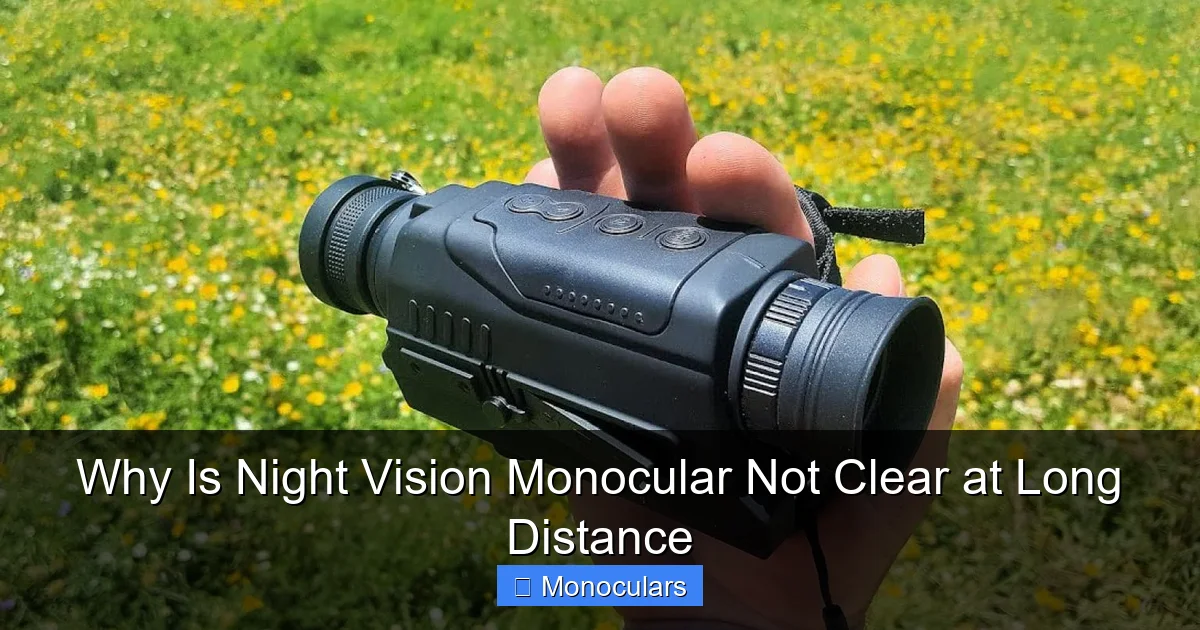
Visual guide about Why Is Night Vision Monocular Not Clear at Long Distance
Image source: outdoorspro.org
Now that we know how night vision works, let’s explore the specific reasons your monocular may not be clear at long distance.
Limitations of Image Intensifier Tubes
The generation and quality of the image intensifier tube directly impact range and clarity. Gen 1 tubes, often found in entry-level monoculars, amplify light about 1,000 times. They work well up to 75–100 yards but become increasingly grainy beyond that. Gen 2 tubes amplify light 20,000 to 30,000 times and offer better resolution, making them effective up to 200 yards. Gen 3 tubes, used in high-end models, can amplify over 30,000 times and maintain clarity at 300+ yards—but they come at a much higher price.
Even within the same generation, tube quality varies. A poorly manufactured tube may have uneven phosphor coating or low signal-to-noise ratio, resulting in a “snowy” or blurry image at any distance.
Atmospheric Interference
Weather and environmental conditions play a huge role in night vision performance. Fog, rain, snow, and even high humidity scatter and absorb light, reducing the amount that reaches your monocular. This effect is similar to how headlights appear dimmer in fog. Dust and smoke also obstruct visibility, especially over long distances.
For instance, on a humid summer night, you might only see clearly up to 150 yards, while on a dry, clear winter night, the same monocular could reach 250 yards. Always consider the environment before expecting long-range clarity.
Optical Design and Magnification
The lens quality and magnification power of your monocular also affect long-distance viewing. Many budget models use plastic lenses with minimal coating, which reduce light transmission and introduce distortion. Even small scratches or smudges can degrade image quality.
Magnification is another double-edged sword. While higher zoom (e.g., 5x or 8x) helps you see farther, it also amplifies any imperfections in the image. Digital zoom, common in digital monoculars, crops and enlarges the image, often resulting in pixelation and loss of detail. Optical zoom is better but still limited by the sensor and tube quality.
A practical tip: avoid maxing out the zoom unless necessary. Often, 3x or 4x provides the best balance between reach and clarity.
The Impact of Ambient Light Conditions
Night vision is highly dependent on available light. The brighter the night (thanks to moonlight, starlight, or artificial sources), the better the image. On a moonless, overcast night, even a high-end monocular will struggle.
Moonlight and Starlight Availability
A full moon can provide up to 10 times more ambient light than a new moon. This means your monocular will perform significantly better during a bright lunar phase. Starlight alone is minimal, but on a clear night, it can still support basic visibility—especially with Gen 2 or Gen 3 tubes.
If you’re hunting or scouting, plan your activities around the lunar calendar. A few nights after a full moon often offer the best balance of light and darkness for stealth.
Artificial Light Sources
Streetlights, security lights, or even distant car headlights can boost visibility. However, they can also cause glare or wash out the image if too bright. Position yourself so that artificial light illuminates your target without shining directly into the monocular.
In rural areas with no artificial light, consider using an external IR illuminator mounted on a tripod. These can extend your effective range by 50–100 yards, depending on power.
Digital Night Vision: Convenience vs. Clarity
Digital night vision monoculars have grown in popularity due to their affordability and features like photo/video capture and Wi-Fi streaming. But they come with trade-offs.
Resolution and Sensor Limitations
Most digital monoculars use low-resolution sensors (e.g., 640×480 or 1024×768). While sufficient for short-range observation, these sensors struggle to resolve fine details at long distances. Compare this to a Gen 3 analog tube, which can resolve over 64 line pairs per millimeter (lp/mm)—far exceeding typical digital sensors.
For example, trying to identify a license plate or facial features beyond 100 yards with a digital monocular is often futile. The image becomes a blur of pixels.
Zoom and Image Processing
Digital zoom in these devices is essentially software-based cropping. It doesn’t add real detail—it just makes the existing image bigger and more pixelated. Some models use image stabilization or noise reduction algorithms, but these can introduce lag or artificial smoothing, further reducing clarity.
If long-range identification is your goal, analog Gen 2+ or Gen 3 monoculars are still the gold standard.
Tips to Improve Long-Distance Clarity
Even with limitations, you can take steps to maximize your monocular’s performance at distance.
Choose the Right Monocular
Invest in a higher-generation tube if long-range clarity is critical. Look for models with at least Gen 2+ tubes and multi-coated glass lenses. Brands like Pulsar, ATN, and Sightmark offer reliable options across price ranges.
Check specifications like resolution (measured in lp/mm), signal-to-noise ratio, and FOM (Figure of Merit). A higher FOM score generally means better image quality.
Use External IR Illuminators
If your monocular has a built-in IR illuminator, consider adding a more powerful external one. Mount it on a tripod and aim it at your target area. This can dramatically extend your effective range, especially in total darkness.
Optimize Focus and Settings
Always adjust the focus wheel carefully. Many users skip this step, assuming autofocus or fixed focus will suffice. But manual focus is crucial for sharp images, especially at distance.
Also, reduce digital noise by lowering gain settings in digital models. Too much gain creates a “snowy” image that obscures details.
Scout During the Day
Familiarize yourself with the terrain in daylight. Note landmarks, distances, and potential obstacles. This mental map helps you interpret night vision images more accurately, even if they’re not perfectly clear.
Maintain Your Device
Keep lenses clean and free of smudges. Use a microfiber cloth and lens cleaner designed for optics. Store your monocular in a dry, temperature-controlled environment to prevent fogging or tube damage.
Conclusion
So, why is your night vision monocular not clear at long distance? The answer lies in a combination of technology limitations, environmental factors, and user expectations. While modern night vision has come a long way, it’s not magic—it’s physics. Light amplification has boundaries, and atmospheric conditions can’t be ignored.
By understanding how your monocular works and what affects its performance, you can make smarter choices. Whether you’re upgrading to a higher-gen tube, using an IR illuminator, or simply adjusting your focus, small changes can lead to big improvements. Remember: clarity at long range isn’t just about the device—it’s about how you use it.
With the right gear and techniques, you’ll be able to see farther and clearer, turning those blurry nightscapes into sharp, actionable views.
Frequently Asked Questions
Why does my night vision monocular look blurry beyond 100 yards?
This is common due to limited light amplification and lower-resolution tubes, especially in Gen 1 or digital models. Atmospheric conditions and lack of ambient light also reduce clarity at distance.
Can I improve long-range clarity with an IR illuminator?
Yes, an external IR illuminator can significantly boost visibility in total darkness. It provides additional infrared light that your monocular can detect, extending effective range by 50–100 yards.
Is digital night vision worse than analog for long distances?
Generally, yes. Digital models often have lower resolution and rely on digital zoom, which degrades image quality. High-end analog Gen 2+ or Gen 3 tubes offer superior clarity at range.
Does weather affect night vision monocular performance?
Absolutely. Fog, rain, humidity, and dust scatter light, reducing image sharpness. Clear, dry nights provide the best conditions for long-distance viewing.
What’s the best magnification for long-range night vision?
Optical zoom between 3x and 5x is ideal. Higher magnification amplifies noise and reduces field of view, making it harder to track moving targets.
How do I know if my monocular is Gen 1, 2, or 3?
Check the product specifications or manufacturer details. Gen 3 tubes offer the best performance but are more expensive. Look for terms like “Gen 2+” or “Gen 3” in the description.