Choosing the right magnification for surveillance binoculars is not about finding the highest power available. It is about finding the power that lets you observe a scene comfortably, track movement accurately, and still hold the optics steady long enough to make critical judgments. In practice, most surveillance tasks are best served by binoculars in the 7x to 10x range, with 8x being the most versatile starting point. Higher magnifications have their place, but for many users they introduce stability problems that outweigh the benefit of seeing a distant object slightly larger.
This guide explains exactly how magnification affects image quality, field of view, brightness, and physical fatigue. You will learn what works for urban monitoring, rural observation, wildlife watching, and vehicle-based surveillance, along with the features that genuinely matter alongside magnification.
Choosing the Right Magnification
Magnification is the first number in a binocular specification. A model listed as 8×42 magnifies the view eight times compared to the naked eye and has a 42mm objective lens. The second number matters just as much as the first, because it determines how much light enters the optic and how bulky the binoculars feel in your hands.
For surveillance, the goal is rarely to identify fine print from a kilometre away. More often, you need to detect movement, follow a person or vehicle, describe clothing or markings, and maintain situational awareness of the surrounding area. That combination favours moderate magnification with a generous field of view.
A practical rule of thumb: hand-held observation becomes noticeably more difficult above 10x. Even a person with a steady grip will notice their pulse creating subtle image movement at 12x or higher. If you must use higher power, plan to mount the binoculars on a tripod or brace them against a stable surface.
Low vs High Magnification
Low magnification, typically 5x to 7x, gives you a wider slice of the scene. You can scan a car park, fence line, or crowd quickly without losing track of where you are looking. Because the image is steadier, your eyes tire less during long watches.
High magnification, typically 12x and above, pulls distant details closer. The cost is a narrower field of view and exaggerated hand shake. At 15x, an object that fills your view may be so unstable that you cannot reliably read a number plate or identify a face without mechanical support.
The table below summarises how magnification affects core surveillance tasks.
| Magnification | Field of View | Stability Handheld | Best Suited For |
|---|---|---|---|
| 5x–7x | Very wide | Excellent | Scanning large areas, close-range monitoring |
| 8x–10x | Moderate to wide | Good | General surveillance, detailed identification |
| 12x–16x | Narrow | Poor without tripod | Fixed-point observation at long range |
Trade-offs Between Magnification and Stability
Every increase in magnification amplifies small movements in your hands, breathing, and even the surface you are standing on. At 8x, these micro-movements are manageable. At 12x, the image can bounce enough to cause fatigue within minutes. At 16x, hand-held use is essentially impractical for detailed work.
A common mistake is buying the highest magnification available and then discovering that the binoculars spend most of their time on a shelf. In practice, a clear 8x image often reveals more useful detail than a shaky 12x image, because your brain can process a stable image far more efficiently.
If long-range identification is a genuine operational need, consider a spotting scope on a tripod as a complementary tool rather than pushing binocular magnification to its limit. A dedicated high-power optic has larger objectives and a stable mount, which solves the shake problem at the source.

An 8×42 configuration is a dependable hand-held choice for extended surveillance sessions.
Credit: www.travelandleisure.com
Common Magnification Ranges for Surveillance
Understanding what each magnification band does well helps you match a binocular to the way you actually observe. The three bands below cover nearly all surveillance scenarios.
5x to 7x: Maximum Awareness
Models in this range are compact, lightweight, and exceptionally easy to hold steady for long periods. The wide field of view makes them ideal for scanning a perimeter, monitoring a group of people, or watching a vehicle move through an intersection.
The trade-off is limited reach. If a subject is more than a few hundred metres away, you will not be able to pull out fine facial or text detail. For security teams working at close to medium range, however, awareness often matters more than magnification.
Because the exit pupil in a 7×50 or 7×42 configuration tends to be large, these binoculars also perform well in dawn, dusk, or overcast conditions. That makes them useful for surveillance tasks that extend across lighting changes.
8x to 10x: The Surveillance Sweet Spot
For most observers, 8x to 10x is the best overall range for surveillance binoculars. An 8×42 or 10×42 model gives enough detail to identify a person or read a sign at moderate distance while remaining usable hand-held.
At 8x, the image is forgiving. You can raise the binoculars to your eyes, find the subject quickly, and follow movement without constant refocusing. At 10x, you gain more reach but lose a little field of view and brightness. The difference is small, but over a long watch, many users find 8x noticeably more comfortable.
If you plan to use the binoculars for security or property monitoring, an 8×42 or 10×42 roof-prism model is the safe default. From there, adjust based on distance and light.
Above 10x: Reach at a Cost
Magnifications of 12x, 15x, or 16x are specialist tools. They make sense only when you have a fixed observation position, a stable mount, and a specific need to identify distant details such as a hull number on a vessel or a person at the end of a long driveway.
Above 10x, the field of view narrows enough that you may lose a moving target entirely between glances. Reacquiring the target takes time, which may not be acceptable during active monitoring. If you choose high power, commit to using a tripod and accept that the binoculars become a semi-stationary system rather than a grab-and-go tool.
Factors Affecting Magnification Choice
Magnification does not exist in isolation. The same 10x figure can produce very different results depending on objective lens size, optical design, and overall instrument weight.
Field of View
Field of view is usually expressed as the width of the scene visible at 1,000 metres or as an angular measurement in degrees. Lower magnification generally gives a wider field, which is why a 7x model helps you find and follow a moving subject more easily.
For surveillance, prioritise field of view when you are monitoring unpredictable movement, such as a public square or a warehouse yard. Prioritise magnification when you are observing a known, relatively static point.
Image Brightness and Exit Pupil
Divide the objective lens diameter by the magnification to get the exit pupil in millimetres. An 8×42 binocular has a 5.25mm exit pupil. A 10×42 model has a 4.2mm exit pupil. In daylight, the difference is negligible because your own pupil is typically smaller than either figure. In low light, the larger exit pupil passes more light to your eye.
For dusk or nighttime surveillance, a larger objective lens is valuable. An 8×56 or 7×50 configuration delivers a bright image when smaller objectives would struggle. The trade-off is weight, because larger glass elements add mass quickly.
Weight, Portability, and Long Sessions
Surveillance is often about waiting. Holding a heavy binocular to your eyes for minutes at a time causes significant arm fatigue, which in turn makes the image shakier. A lightweight 8×32 or 8×42 model may be far more practical over a multi-hour watch than a bulky 10×56 model, even if the larger optic is technically brighter.
If the binoculars are used mainly from a vehicle or fixed post, weight is less important. If they are carried on a belt, neck strap, or in a pack, every gram matters.
Application-Based Magnification
The right power depends heavily on what you are watching and where.
Urban Surveillance
In a city, distances are often short to moderate, and subjects move quickly between obstacles. A 7x to 10x magnification with a wide field is ideal. The priority is tracking movement through busy streets, doorways, and intersections, not extracting fine detail from extreme range.
An 8×42 is a strong default for urban use. It balances a useful field of view with enough magnification to read a sign or describe clothing at realistic urban distances. Compact 8×32 models also work well when discretion and portability matter.
Rural and Perimeter Monitoring
Open ground, fence lines, and long driveways favour slightly more reach. A 10×42 or 10×50 model pulls distant subjects closer while still being usable hand-held for short periods. If your observation point is fixed, you can also consider a 12x model on a tripod or use a larger objective for better dawn and dusk performance.
In rural settings, resistance to moisture and internal fogging matters more than in sheltered urban use. Look for nitrogen-purged or argon-filled optics with O-ring seals, since temperature swings and damp air can fog internal lenses. For more on this, see how weatherproof construction affects choosing hunting optics that resist moisture and fog.
Wildlife Observation and Nature Monitoring
Watching animals at a distance requires enough magnification to observe behaviour without disturbing the subject. Most field observers settle on 8x to 10x, with 8x preferred in dense woodland and 10x useful in open terrain. Higher magnifications can work from a static hide, but they demand a tripod.
A wider field helps you locate a moving animal, keep it in frame, and follow it when it changes direction. If you are new to this type of observation, the guidance on selecting a first pair of birding binoculars translates directly to wildlife surveillance.
Security and Tactical Use
Security teams and tactical observers often request the highest magnification available, assuming more power means more information. In practice, most professional users pair a moderate handheld binocular with a dedicated long-range optic. A 10x to 12x handheld model covers most tasks, while a spotting scope handles positive identification at extreme distance.
For surveillance that may continue into darkness, image stabilisation and night vision become as important as raw magnification. A stabilised 12x or 14x binocular can outperform an unstabilised 10x model for handheld use, though stabilised instruments cost significantly more.
Key Features That Complement Magnification
Magnification is only one part of the system. Several features determine whether the optic is genuinely usable for surveillance, or merely powerful on paper.
Image Stabilisation
Image stabilisation uses gyroscopic or electronic correction to offset hand movement. This technology lets you hand-hold higher magnifications, such as 12x or 14x, with far less visible shake than a conventional binocular would produce.
The benefit is real. A stabilised 12×36 can deliver usable detail that an unstabilised 12×50 cannot hand-held. The trade-offs are cost, battery dependence, and added weight. For occasional users, standard 8x or 10x optics are simpler and more affordable. For professionals who must observe at long range without setting up a tripod, stabilisation is worth serious consideration.
Low-Light and Night Capability
Standard binoculars amplify ambient light but cannot see in total darkness. If you need to observe after sunset, look for a large objective lens relative to magnification. A 7×50 or 8×56 model gathers significantly more light than an 8×32 or 10×42.
True night vision—image intensification or thermal imaging—is a separate category. These instruments allow observation in near-total darkness but are heavier, more expensive, and often limited to monocular form factors. For most civilian and property-surveillance tasks, an excellent low-light binocular plus ambient lighting is sufficient.
Waterproofing and Fog Resistance
Surveillance optics are used outdoors in rain, humidity, and temperature changes. Internal fogging can render a binocular useless for hours. Look for waterproof, nitrogen-purged, and fog-proof construction as a baseline.
Sealed optics also resist dust and internal fungal growth, which matters if the binoculars live in a vehicle or storage area. If condensation is already a problem with your current pair, the methods for preventing fogged lenses during extended observation are directly applicable to surveillance duty.

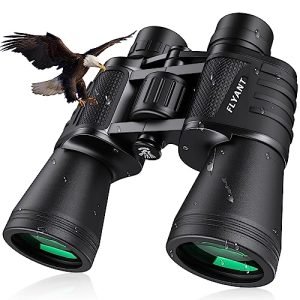
Larger objective lenses gather more light, which helps maintain image brightness at higher magnification.
Credit: www.amazon.com

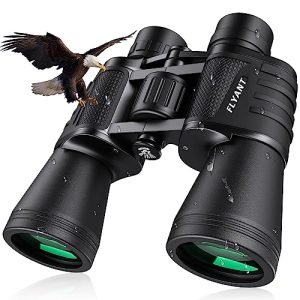
Optics intended for field surveillance should withstand rain, dust, and temperature swings.
Credit: www.amazon.com
How to Choose: A Simple Decision Path
If you are unsure where to start, work through the following questions in order.
- What is your primary distance? Short-range urban or indoor observation points toward 7x or 8x. Long rural sightlines point toward 10x or 12x.
- Will you watch mostly in daylight or across dusk? For significant low-light use, choose a larger objective such as 42mm, 50mm, or 56mm.
- Will you be hand-holding or using a support? Hand-held work above 10x is difficult. If you must exceed 10x, budget for a tripod or choose stabilised optics.
- How long will an average session last? Long sessions favour lighter weights and lower magnification. Fatigue directly undermines image stability.
- What is the weather where you operate? Wet or humid environments demand sealed, fog-proof construction.
Once you have answered those questions, you can choose a specification with confidence rather than guessing.
A practical starting point: if you can only have one surveillance binocular, choose an 8×42 or 10×42 waterproof roof-prism model. It covers the broadest range of realistic scenarios and remains comfortable to use for extended periods.
Real-World Scenarios: Matching Magnification to the Task
The following scenarios illustrate how the principles above apply in practice.
Watching a property boundary at night. A 7×50 or 8×56 configuration is ideal. The large exit pupil keeps the image usable in low light, while the moderate magnification keeps the view wide enough to scan a fence line without losing the subject.
Monitoring a public event. An 8×32 or 8×42 model offers portability, a steady image, and enough detail to describe individuals or vehicles. The wider field is more valuable than extreme reach.
Long-range observation from a fixed post. A 12×50 or 15×56 model on a tripod can work, but consider whether a spotting scope would do the job better. Binoculars above 12x offer dimmer, narrower views that quickly become tiring.
Mixed daylight and dusk patrols. A 10×42 or 10×50 model gives extra reach over an 8x model while retaining acceptable low-light performance. It is a reasonable compromise when long-range daylight work outweighs the need for a huge field of view.
In many of these scenarios, proper focusing technique matters as much as the magnification figure itself. The method for quickly bringing a birding binocular into sharp focus applies equally to surveillance use, where a missed focus adjustment can mean losing sight of a moving subject.
Maintenance and Long-Term Reliability
A surveillance binocular is a working tool, not a display piece. It should survive in a vehicle glovebox, on a desk by a window, or inside a pack during bad weather. Routine care keeps the seals intact and the optics clear.
- Wipe lenses only with a clean microfibre cloth. Grit on the lens surface causes permanent scratches.
- Rinse off salt or grit with clean water before wiping. Salt crystals are abrasive and will damage coatings.
- Store in a dry location with a desiccant if possible. This prevents internal fogging and fungal growth in humid climates.
- Do not attempt to disassemble sealed optics. Internal repairs require specialist tools and clean-room conditions.
If a pair is mishandled or dropped, the collimation—the alignment of the two barrels—can shift. A binocular that is out of collimation causes eyestrain and double images. In that case, the approach to servicing a damaged observation binocular is worth reviewing before you replace it.
Regular lens cleaning may feel like a minor task, but dirty optics reduce effective brightness and contrast, which has the same practical effect as losing magnification. The steps for keeping multi-coated optics clear over time transfer directly to adult surveillance models.
Frequently Asked Questions
What magnification is best for hand-held surveillance?
For handheld use, 8x to 10x is the best range. It provides useful detail without the excessive image shake that appears at 12x and above. Many long-term observers prefer 8x because it is more comfortable over multi-hour sessions.
Can I use 12x or 16x binoculars without a tripod?
For short glances, yes. For detailed observation, no. Above 10x, hand tremor becomes obvious enough to reduce the information you can extract. A 12x binocular on a tripod or a stabilised 12x model is far more effective than a conventional 12x held in free space.
Does higher magnification mean better surveillance?
Not automatically. Higher magnification narrows the field of view, reduces image brightness for a given objective size, and increases shake. The best surveillance optic is the one that lets you see the subject clearly and reliably under real conditions, which usually means moderate power.
Is a zoom binocular good for surveillance?
Zoom binoculars offer a range of magnifications, such as 8–16x, but they introduce trade-offs. The zoom mechanism adds moving parts that can let in moisture over time, and image clarity is often slightly lower than a fixed-power model at the same price. If you need flexibility, a quality fixed 8x or 10x pair plus a tripod-mounted spotting scope is usually a better long-term solution. The mechanics behind a fixed-power roof prism system also tend to hold alignment well under regular field use.
What objective lens size should I pair with 10x?
A 42mm objective is the standard choice for 10x binoculars. It balances brightness, weight, and field of view well. For heavier low-light use, a 50mm objective improves twilight performance but adds noticeable bulk.
Are there standards that define what a binocular actually delivers?
Yes. Independent testing organisations such as the British Standards Institution publish methods for measuring magnification, field of view, transmission, and durability. When comparing models, checking whether the manufacturer uses an established test standard—such as those referenced by BSI—can help you separate measured specifications from marketing claims.
Conclusion
The best magnification for surveillance binoculars is usually not the highest number on the box. For the vast majority of handheld observation, 8x to 10x offers the best balance of detail, stability, brightness, and field of view. Choose 8x when you value comfort and tracking ability. Choose 10x when you need more reach and are willing to accept a slightly narrower view and a little more effort to hold steady.
Match the objective lens size to your lighting conditions, choose waterproof construction if the optics will see weather, and be realistic about hand-holding. If you need magnification above 12x, plan for a tripod or a spotting scope rather than fighting the shake.
Above all, prioritise a stable, clear image over raw power. The goal of surveillance is not to magnify a subject as much as possible. It is to see the subject well enough to observe, track, and describe it accurately—and that is exactly what well-chosen moderate magnification delivers.